 ChessPuzzlePrint
USCF Rating Calculator
Enter your rating, how many rated games it is based on and your results, and see your estimated new US Chess rating with every step of the calculation.
What the USCF rating calculator works out
The USCF rating calculator estimates your new US Chess rating after one event. You enter your current rating, your number of rated games before the event, and each game's opponent rating and result, and it shows your estimated new rating and the change. It follows The US Chess Rating System by Mark Glickman and Thomas Doan (version of April 6, 2026). The arithmetic runs in your browser, and nothing you type is uploaded. The tool is not affiliated with US Chess.
The result is an estimate, not an official rating. US Chess publishes the official figure after its own processing, and the reasons for any difference are explained below. Use the calculator to see how a set of results is likely to move your rating and which games matter most.
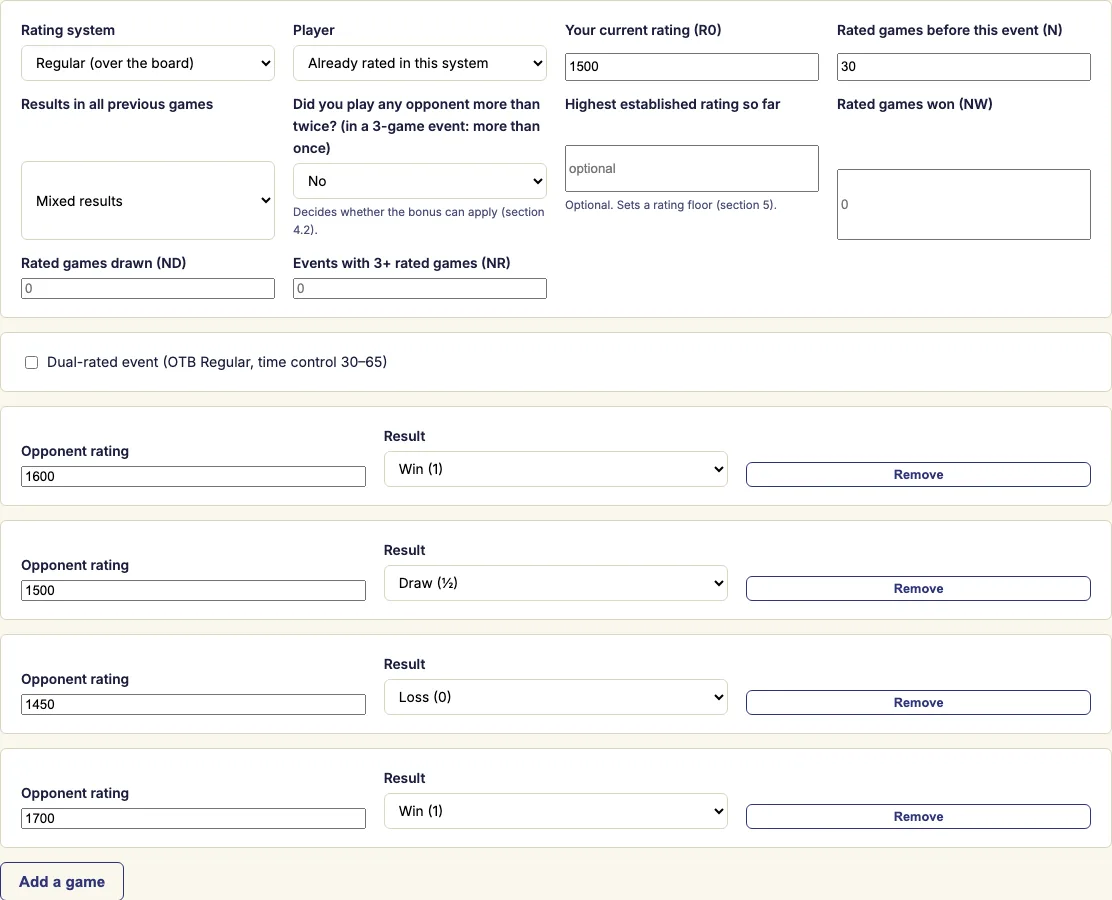
How to use the USCF rating calculator
- Choose the Rating system; the formulas are the same for all six.
- Choose Player: "Already rated in this system", or one of the unrated options — with a FIDE rating, with a known age, or an adult or junior with no birth date.
- For a rated player, type Your current rating (R0) and Rated games before this event (N), and set Results in all previous games to Mixed results, All wins or All losses. For an unrated player, type the FIDE rating or the age instead; the calculator works out the starting rating.
- Enter the Opponent rating and the Result (Win, Draw or Loss) of each game. Press Add a game for every further game, or Remove to delete one.
- Answer Did you play any opponent more than twice? (in a 3-game event: more than once). This decides whether bonus points are possible.
- Tick Dual-rated event (OTB Regular, time control 30–65) only for an over-the-board Regular rating in a dual-rated event.
- To apply the rating floor, type Highest established rating so far; for the personal absolute floor of an over-the-board rating you can also enter your rated wins, draws and events with 3 or more rated games.
- Read the result. The breakdown lists each game's expected score, then S, E, N*, N′, K, K×(S−E), the bonus, the unrounded result, the floor used, the rounded rating and the change.
Compare the rounded figure with your official result.
How is the USCF rating calculated?
Your new rating is your old rating plus K times the difference between your score S and your expected score E. Your score is your points from the event, with a win counting 1, a draw 0.5 and a loss 0. Your expected score is the sum of the expected score for each game, where each game's expectancy is 1 / (1 + 10^(−(R − Ri)/400)), with R your rating and Ri the opponent's rating.
K controls how far a result moves you. It is 800 / (N′ + m), where m is the number of games in this event and N′ is the smaller of your number of games N and N*. N* is 50 / √(0.662 + 0.00000739 × (2569 − R)²) for ratings up to 2355, and 50 above 2355. For a rating of 1700 with 30 games, N* is 20.0, so N′ is 20. With N′ = 20 and m = 6, K is 30.77.
The standard formula applies when you have more than 8 previous games and your previous results were mixed. If you have 8 or fewer previous games, or all your previous games were wins or all losses, a special formula is used instead. It finds the rating at which the expected score, using a straight-line expectancy of 0.5 + (R − Ri)/800 within 400 points, equals your adjusted score. The result of this formula is capped at 2700.
How do I estimate my first USCF rating?
An unrated player needs a starting rating before the calculator can work out a change. The starting rating can come from a FIDE rating, from age, or from a default. From a FIDE rating, the figure is −1073 + 1.5667 × FIDE up to 2000, and 20 + 1.02 × FIDE above 2000. From age, it is 50 × age for ages 2 to 26, and 1300 above 26. If there is no birth date, the default is 1300 for an adult and 750 for a junior.
In the calculator, choose the matching unrated option under Player and it works out the starting rating for you. A first rating is then calculated with the special formula, because the player has no previous games.
A rating is called established when it is based on more than 25 games. The standard formula already takes over after 8 games, but while N′ is small K is large, so early ratings move much more than later ones.
Examples
Rating 1700, N = 30 (N* 20.01, N′ 20.01)
1800: 1, 1750: 1, 1700: 1, 1650: 1, 1600: ½
S 4.5, E 2.50, K 31.98
K(S − E) 63.97, bonus 41.61
Result 1805.58 → 1806 (+106)
Unrated, FIDE 1800 → start 1747, N = 5
1700: 1, 1750: ½, 1900: 0
Special formula (N ≤ 8)
Result 1760.63 → 1761 (+14)
Rating 1350, N = 40, highest established 1500
900: 0, 900: 0, 900: 0
Unrounded 1223.53
Floor 1300 applied
Result 1300
Questions and answers
What are USCF bonus points?
Bonus points are an extra gain in some events. They apply in an event of 3 or more games where no opponent was met more than twice, or more than once in a 3-game event. The bonus is max(0, K(S − E) − B·√m′), where m′ = max(m, 4) and B = 10 since 1 January 2025.
What is the USCF rating floor?
No rating goes below 100. If you tick "Highest established rating so far," the floor is your highest rounded established rating minus 200, rounded down to a 100-point level between 1200 and 2100. For example, 1941 gives a floor of 1700. A separate personal floor also applies, calculated as min(100 + 4 × wins + 2 × draws + events with 3 rated games, 150).
Why is the official rating different from the estimate?
The official run rates all players in the event together. It gives unrated opponents temporary ratings and, in its last step, uses the opponents' intermediate post-event ratings. This calculator uses the opponent ratings you type in. It also does not include money floors, the Original Life Master 2200 floor or match limits.
What is a good USCF rating?
A rating only measures your strength relative to other rated players, so whether a rating is good depends on what you compare it with. Your club, your region or your own goals are more useful reference points than any single number. The calculator estimates changes to your rating and does not rate playing strength on its own.
How many games do I need before my rating is established?
Your rating is established when it is based on more than 25 games. Until then, the calculator still works, but the effective games limit N′ can keep changes larger than they would be for an established rating.
Can the calculator handle online ratings?
Yes. The three online systems use the same formulas as the over-the-board systems. Choose the online system you are rated on in the rating system dropdown, then enter your games as you would for any other event.
Related chess tools
Updated