 ChessPuzzlePrint
Swiss System Tournament Generator
Enter your players, choose the number of rounds and pair every round in the browser. The tournament is saved on this device, and standings are updated after each result.
What the Swiss system tournament generator does
The Swiss system tournament generator runs a Swiss-system chess tournament in your browser. It pairs each round, takes the results you enter and keeps the standings, so you can run a club or school event without installing anything. In a Swiss tournament every player takes part in every round, but players meet opponents with similar scores rather than everyone meeting everyone. That makes the format practical when you have more players than rounds. This page explains how the pairing works, how to run the generator, and how ties are settled. The method is a simplified Dutch-style pairing, so for FIDE-rated play, use an endorsed program.
How to use the Swiss system tournament generator
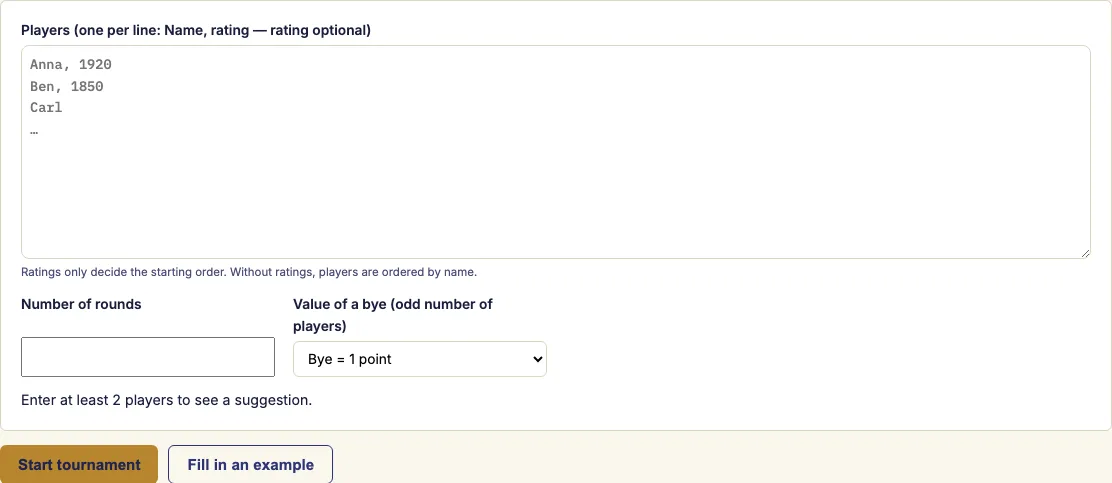
- Type the players in the box labelled "Players (one per line: Name, rating — rating optional)". For example:
Anna, 1650. A name without a rating is also fine. - Set "Number of rounds". If you are unsure, use the suggested number shown for your player count.
- Set "Value of a bye (odd number of players)" to 1 point, ½ point or 0 points. This only matters if you have an odd number of players.
- Press "Start tournament". To try the tool first, press "Fill in an example" to add a sample list of players.
- Enter the result for each board: —, 1-0, ½-½, 0-1, 1F-0F (White wins by forfeit) or 0F-1F (Black wins by forfeit).
- When every result of the round is in, press "Pair next round".
- Check the standings after each round. Repeat steps 5 and 6 until the last round is finished.
- After the final round, read the standings table: it is already sorted by points and tie-breaks, so the top line is the winner.
If you enter a round by mistake, "Undo last round" removes the most recent round. "Copy pairings" and "Download standings CSV" export your tournament, and "Print" prints it. To clear everything, press "New tournament" and confirm the question "Delete this tournament and start again?" The pairings and standings you make here are free to use for your own events, including paid ones.
How does Swiss pairing work?
In a Swiss system every player plays every round, but no two players meet twice. Each round pairs players with the same or similar scores, so the event stays competitive as it goes on. The same players and results always produce the same pairings.
The starting order comes first. Players are ranked by rating, highest first, then unrated players, then by name. In round 1 the top half plays the bottom half: seed 1 meets seed n/2+1, seed 2 meets seed n/2+2, and so on. The top seed has White on board 1, and colours alternate down the boards.
Later rounds sort players by score, then by starting rank. Each score group is paired top half against bottom half. If a player cannot be paired inside their group without a repeat, they float down to the next group. The search backs up when needed, and if no rematch-free pairing exists, the tool reports it.
Colours are chosen to stay balanced. Each player gets the colour they have had less often, otherwise the opposite of their last game. After the same colour twice in a row, a player gets the other colour where possible.
How are ties broken in a Swiss tournament?
Players are first ranked by points. Ties are then broken by Buchholz, Buchholz Cut-1, Sonneborn–Berger and starting rank, in that order.
Buchholz is the sum of the final scores of a player's opponents. A bye counts as an opponent with 0 points. Cut-1 drops the lowest of those scores, which reduces the effect of one weak opponent. Sonneborn–Berger adds the opponent's final score for each win and half of it for each draw.
This is a simpler version than FIDE's rule, which uses a virtual opponent for byes. The standings table shows Rank, Name, Rating, Points, Buchholz, Buchholz Cut-1, Sonneborn–Berger and Wins, so you can see exactly where each tie-break value comes from.
Examples
Round 1
Board 1: Anna (White) – Eve (Black)  1-0
Board 2: Finn (White) – Ben (Black)  0-1
Board 3: Carl (White) – Grace (Black)  1-0
Board 4: Hugo (White) – Dana (Black)  0-1
Round 3
Board 1: Anna (White) – Ben (Black)  1-0
Board 2: Eve (White) – Carl (Black)  0-1
Board 3: Dana (White) – Finn (Black)  1-0
Board 4: Grace (White) – Hugo (Black)  1-0

Standings after round 3 (the higher-rated player wins every game)
1. Anna     3  BH   5  C1   4  SB    5
2. Ben      2  BH   6  C1   5  SB    3
3. Carl     2  BH   5  C1   4  SB    2
4. Dana     2  BH   3  C1   3  SB    1
5. Eve      1  BH   6  C1   5  SB    1
6. Finn     1  BH   4  C1   4  SB    0
7. Grace    1  BH   3  C1   3  SB    0
8. Hugo     0  BH   4  C1   3  SB    0
7 players, 5 rounds: bye in each round
Round 1: Grace
Round 2: Dana
Round 3: Carl
Round 4: Ben
Round 5: Finn
Questions and answers
How many rounds does a Swiss tournament need?
The suggested number is log2 of the number of players, rounded up. For example, 8 players gives 3 rounds and 20 players gives 5. It is a rule of thumb for one clear winner when games are decisive, and draws can still leave ties. The maximum is one round fewer than the number of players.
What is a bye in a Swiss tournament?
With an odd number of players, one player has no game in a round. That player receives the bye value you set: 1 point, ½ point or 0 points. The bye goes to the lowest-ranked player of the lowest score group who has not had one, so nobody gets two byes.
Is this a FIDE-endorsed pairing program?
No. The method is a simplified Dutch-style pairing written for this site. It is not the full FIDE Dutch system and not a FIDE-endorsed pairing program, so use an endorsed program for FIDE-rated events.
How do I set up a chess tournament?
A standard Swiss event needs three decisions: who plays, how many rounds, and how a bye is scored. Once those are set and the tournament has started, you only enter results round by round. Your players, ratings and results are saved in this browser, so you can return to the event later.
Can I correct a result after pairing the next round?
Only the results of the latest round can be changed. To correct an earlier round, press "Undo last round" until that round is the latest, fix the result and pair again; the pairings that follow may change.
Can I use the Swiss pairings and standings sheets for commercial use, such as a paid tournament?
Yes. The pairings and standings you print or export are royalty-free for personal, club and commercial use, including paid events and printables you sell. No credit is required, and the only thing you may not do is copy this generator itself to run a competing service.
Related chess tools
Updated