 ChessPuzzlePrint
Stalemate in Chess
Paste a position to see whether it is stalemate, checkmate or neither, then test yourself with a quiz.
What this stalemate checker does
Stalemate is a draw that happens when the player to move has no legal move and the king is not in check. If the king is in check and has no legal move, the position is checkmate and the game is lost instead. The two look almost the same, which is why stalemate costs players so many half-points.
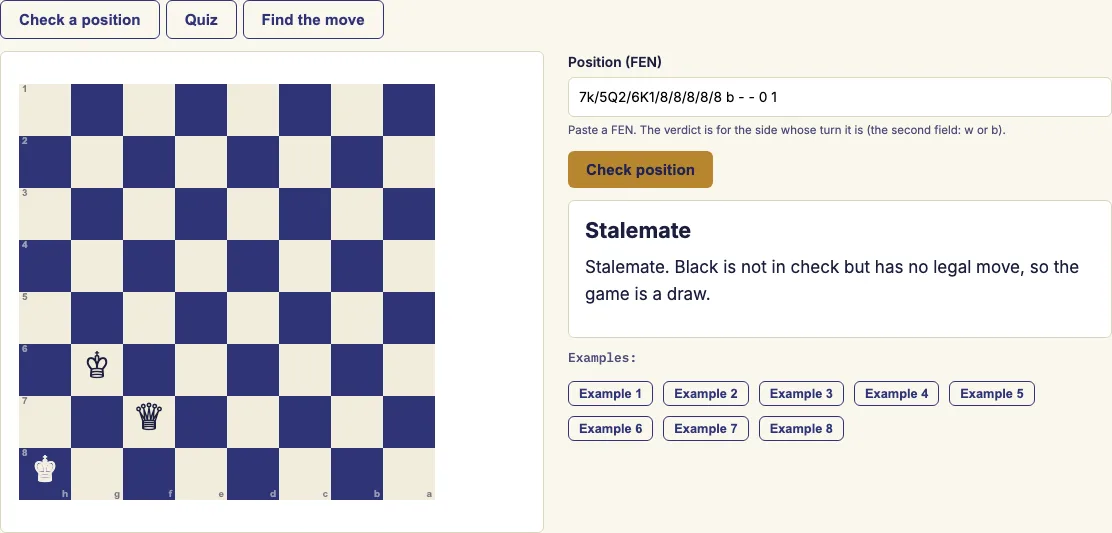
This tool lets you see the difference. Check a position takes any FEN and says whether the side to move is checkmated, stalemated, only in check, or in a draw by insufficient material. Quiz shows eight positions and asks you to call them. Find the move sets three positions where a queen move gives mate and another gives stalemate.
The verdicts come from a chess rules library and run in your browser.
How to use the stalemate checker
To check a position for stalemate:
- Open Check a position and paste a FEN into the box, then press Enter or Check position. You can also click one of the eight examples.
- Make sure the second field of the FEN is the side to move, w for White or b for Black. The verdict is always about that side.
- Read the heading on the right: Checkmate, Stalemate, Check not mate, Draw (insufficient material) or Neither. The sentence below it says why.
- For practice, open Quiz, look at the board and press Checkmate, Stalemate or Neither. The answer explains which squares are covered.
- In Find the move, click the piece and then the square. The tool plays the move and tells you if it was mate, stalemate or something else. Use Show the answer or Try again as needed.
- If the FEN is not valid, or the position is impossible (for example the side that just moved is in check), the tool says so instead of giving a verdict.
- To test a position from your own game, set it up in the board editor, copy the FEN and paste it here. Add the side to move as w or b.
Your best quiz run and the number of solved tasks are kept in this browser only.
What is stalemate in chess?
Article 5.2.1 of the FIDE Laws of Chess (in force from 1 January 2023) says the game is drawn when the player to move has no legal move and the king is not in check. Both parts must be true. A player who still has any legal move, even a bad one with a single pawn, is not stalemated.
Compare Article 5.1.1: the game is won by the player who has checkmated the opponent's king. Checkmate means the king is attacked and cannot escape. Stalemate means the king is not attacked but nothing at all can move.
How is stalemate different from checkmate?
The only difference is whether the king is attacked right now. With the same pieces, a queen next to the king can give mate, and a queen a knight's move away can give stalemate. The Find the move tab uses exactly this: Qg7 mates the black king on h8, while Qg6 leaves it with no move and no check.
A third kind of draw is easy to confuse with stalemate. A draw by insufficient material, such as king and bishop against king, ends the game even though the side to move can still move. The checker labels it separately.
How do you avoid stalemating your opponent?
Before you move when you are ahead, count the squares the lone king can still reach after your move. If it has none and is not in check, you are about to draw a won game. Give check or leave the king one square. Positions with a pawn, such as the king on a8 against a pawn on a7 and a king on a6, show that a stalemate can arise with very little material.
The same care applies in reverse. If you are the one losing, a stalemate is a way to save the game. Look for moves that give up pieces so that your king is left with no square and no check, and the opponent has to take or lose the win. That idea is why a won ending against a lone king still has to be played accurately to the last move.
The three tasks in Find the move all use a queen and king against a lone king, where beginners most often go wrong. After each one, play the other queen moves too and read the verdict; seeing how many of them stalemate makes the danger concrete.
Examples
Questions and answers
Is stalemate a win, a loss or a draw?
A draw. Each player scores half a point. The FIDE Laws call it a draw, not a loss for either side.
Can you be stalemated with many pieces on the board?
Yes, but it is rare. Every piece must be blocked or pinned so that no legal move exists, and the king must not be in check. Endgame positions are the usual case.
Is it stalemate if my only moves would put my king in check?
Yes. Moves that leave your own king attacked are illegal. If every other move is also blocked, the position is stalemate.
Does the tool check for threefold repetition or the fifty-move rule?
No. It looks at one position only: checkmate, stalemate, check, insufficient material or none of these.
Why does the page not offer an engine or a computer opponent here?
The checker only needs to know the rules, not the best move. It generates every legal move for the side to move and counts them, so the answer is exact and instant.
Why does the verdict say Neither?
Because the side to move is not in check and still has at least one legal move, so the game goes on.
Related chess tools
Open-source components used by this tool: chess.js (BSD-2-Clause); ChessPieces font (Noto Sans Symbols 2 subset) (SIL OFL 1.1).
Updated