 ChessPuzzlePrint
Scholar's Mate
Watch the four-move checkmate, then try the defence yourself.
What this scholar's mate page does
Scholar's Mate is a checkmate in four moves for White, and this page lets you watch the trap play out and test whether you can stop it. It runs in your web browser, is free, needs no sign-up, and uploads nothing. Every move on the board is checked by the chess.js library, so only legal moves are played.
The page has two tabs. "Watch the trap" is the default and plays the seven half-moves one at a time, with a sentence explaining each one. "Can you stop it?" stops after 3. Qh5 and asks you to choose Black's reply, so you can test your defence before White delivers the mate.
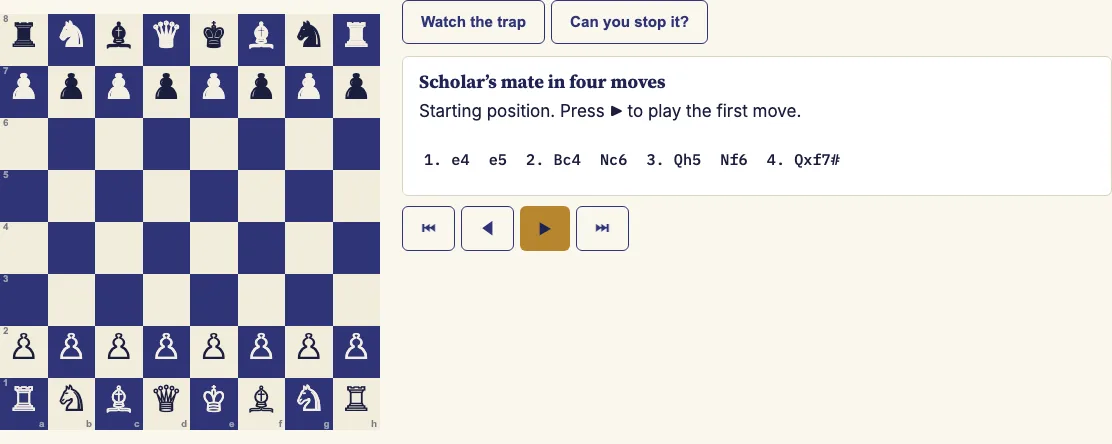
How to use the Scholar's Mate tool
- Stay on the "Watch the trap" tab, which opens by default.
- Press ▶ to play the next move, and ◀ to go back one move.
- Press ⏮ to return to the start, or ⏭ to jump to the last move.
- Click any move in the move list to jump straight to that position.
- Open the "Can you stop it?" tab. The game stops after 3. Qh5.
- Click one of your Black pieces. Its legal squares are marked with dots.
- Click the square you want that piece to move to.
- Check whether White has a checkmate in reply. If you want to start the quiz again, press "Try again", which resets it.
- Use the move list: it shows every half-move of the trap, and clicking a move jumps to that position.
- In the quiz, press Try again after any reply to go back to the position after 3. Qh5 and test another defence.
Use the tabs in order. Watch the full trap first so you can see which squares matter, then return to the quiz. The quiz tests only one decision, Black's reply to 3. Qh5. A reply that avoids immediate mate is not automatically a good move, so think about the position after it too.
What are the moves of Scholar's Mate?
Scholar's Mate is 1. e4 e5 2. Bc4 Nc6 3. Qh5 Nf6?? 4. Qxf7#, a checkmate in four White moves. The double question mark marks Black's mistake, 3...Nf6, which attacks the queen but leaves f7 undefended.
Each White move has a job. 1. e4 opens the diagonal from d1 to h5 for the queen. 2. Bc4 aims the bishop at f7 along the c4 to f7 diagonal. 3. Qh5 aims the queen at f7 along the h5 to f7 diagonal. 4. Qxf7 takes the pawn with check.
What is Scholar's Mate?
Scholar's Mate is a trap that ends the game in four moves when the opponent ignores a threat on f7. A checkmate means the king is in check and has no legal way to escape, so the game is over.
The trap depends on the pawn on f7, which only the king defends at the start of the game. Attacking that one square with two White pieces creates a threat that Black must answer on move 3.
How do you stop Scholar's Mate?
Black stops the mate by defending f7 or blocking the attack before White's fourth move. The best-known defences are 3...g6, which attacks the queen and blocks the h5 to f7 line, and 3...Qe7 or 3...Qf6, which defend f7 with the queen.
3...Nh6 also works, because the knight defends f7. In the quiz, 8 of the 28 legal replies after 3. Qh5 are safe: g6, Qe7, Qf6, Qg5, Qh4, Ke7, Nh6 and d5. The common failures are 3...Be7, 3...Bc5, 3...Bd6 and 3...Rb8, which all lose to 4. Qxf7#. "Safe" means only that White has no mate in one move, not that the move is good.
Why does Scholar's Mate work?
It works because f7 is defended only by the king, and White attacks it with two pieces at once. The bishop on c4 and the queen on h5 both reach f7, so the king cannot take the queen on f7 because the bishop protects it.
The king also has nowhere to go. Its own queen on d8, its bishop on f8 and its pawn on d7 block three squares, and the queen on f7 covers e7. After 3...Nf6, Black's knight has left g8 without guarding f7, so nothing stops 4. Qxf7#.
Is Scholar's Mate a good opening?
No, it is a trap, not a sound plan. It only succeeds when the opponent makes a mistake, and it takes the queen out early, which is a risk for White when Black responds well.
In the quiz, 20 of Black's 28 replies lose at once, which explains why beginners fall for it. The good defences are few and simple to learn, so once you know them the trap rarely works.
Examples
Questions and answers
Is Scholar's Mate the same as Fool's mate?
No. Fool's mate is a checkmate in two moves for Black, while Scholar's Mate is a checkmate in four moves for White.
Does Black have to fall for Scholar's Mate?
No. Black can defend with 3...g6, 3...Qe7, 3...Qf6 or 3...Nh6, which all stop the mate.
Why does 3...Nf6 lose?
Nf6 attacks the queen but does not defend f7, so 4. Qxf7 is checkmate.
Does the tool check my moves?
Yes. The chess.js library checks every move on the board, so illegal moves are not played.
How do I play a move in the quiz?
Click one of your pieces, then click one of the dotted squares where it can legally move.
What does "safe" mean in the quiz?
A safe reply is one after which White has no checkmate in one move. It does not mean the reply is the best move.
Why does Black have so many bad replies?
After 3. Qh5 the queen and the bishop both attack f7. Of Black's 28 legal replies, only 8 leave White without a checkmate in one move (g6, Qe7, Qf6, Qg5, Qh4, Ke7, Nh6 and d5); the other 20 allow Qxf7#.
Can I try more than one defence?
Yes. Press Try again to return to the position after 3. Qh5 and pick another reply as often as you like.
Related chess tools
Open-source components used by this tool: chess.js (BSD-2-Clause).
Updated