 ChessPuzzlePrint
Round Robin Generator
Type the players’ names and get every round of an all-play-all tournament — board numbers, who has White and who has Black — laid out as the FIDE Berger tables prescribe.
What the round robin generator does
The round robin generator is a free, browser-based tool that builds a complete round robin schedule, in which every player meets every other player once. Enter your player names or a number of players, choose a single or double round robin, and the tool lays out every round for you.
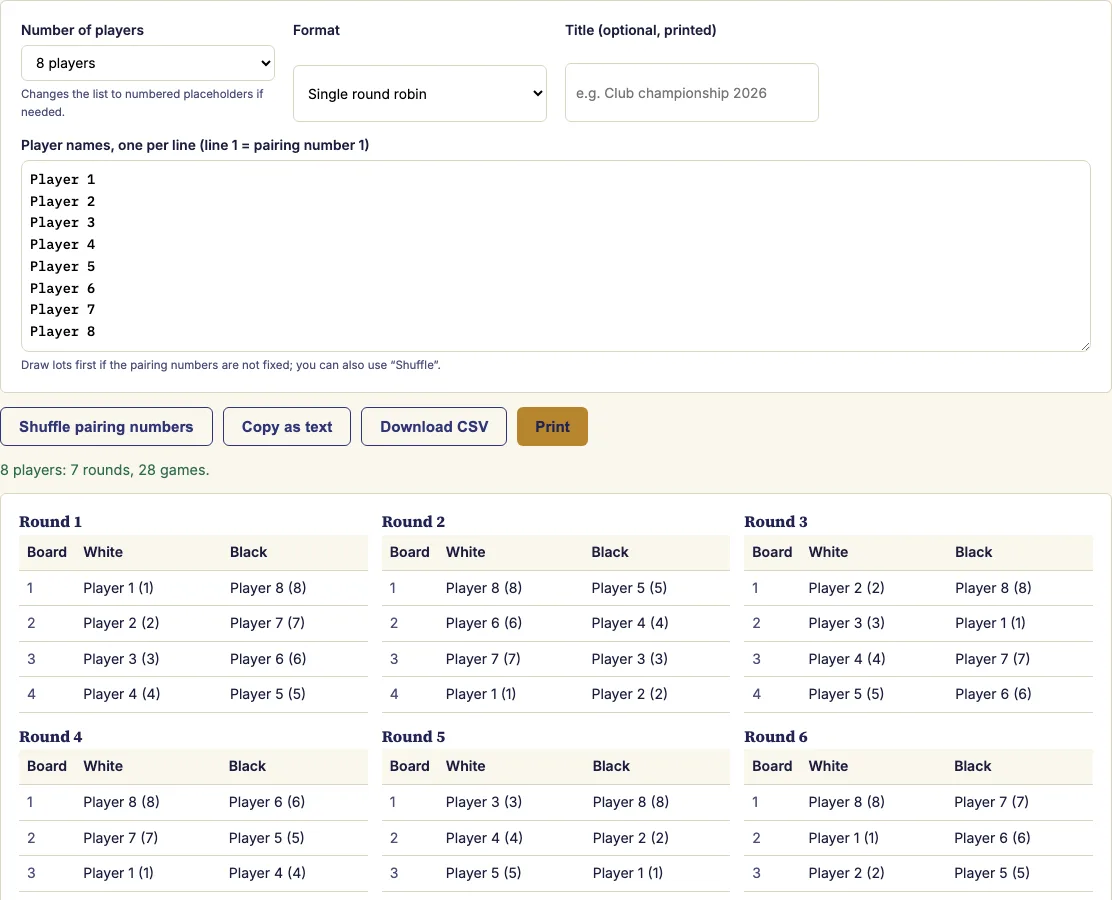
It works for chess tournaments, club leagues, pickleball and other all-play-all events. Each player gets a pairing number, and every round table shows the board number, who plays White and who plays Black, and the player who sits out when the number of players is odd. The pairings follow the Berger tables that FIDE publishes, so you can check the draw against the official tables. When the schedule is ready, you can copy it as text, download it as a CSV file or print it.
How to use the round robin generator
- Choose the number of players, or type the names into the box, one per line. The first line is pairing number 1, the second is pairing number 2, and so on. If you have already drawn lots, type the names in the drawn order.
- If the pairing numbers have not been drawn yet, press "Shuffle pairing numbers" to put the names in a random order.
- Choose a single or double round robin. For a double, keep the swap of the last two rounds switched on unless your regulations say otherwise.
- Read the rounds. Each table lists the board number, White and Black, with the pairing number in brackets. The player with the bye is shown underneath the table.
- Copy the schedule as text, download it as a CSV file for a spreadsheet, or print it. Open "Colours per player" to see each player's colour sequence.
Add a title and it is printed above the rounds. The controls are left out of the printout, so only the schedule appears on paper. The address keeps your names and settings, so a bookmarked link brings back the same schedule. With an odd number of players, each player has exactly one bye in a single round robin, so check the bye line in every round before you start. The schedules you make here are free to use for your own events or in products you sell.
How many rounds and games does a round robin need?
A round robin needs one game for every pair of players. With n players, the total is n × (n − 1) / 2 games. For 6 players that is 6 × 5 / 2 = 15 games, and for 8 players it is 28.
The number of rounds depends on whether the number of players is even or odd. With an even number of players, a single round robin takes n − 1 rounds, and everyone plays in every round. With an odd number, it takes n rounds. A double round robin plays the full cycle twice, so every pair meets twice, once with each colour.
How are colours handled?
In a single round robin with an even number of players, each player has one colour one more time than the other. With an odd number, players have equal colours or a difference of two, depending on when their bye falls. With the default swap of the last two rounds switched on, no player in the generated schedules gets the same colour three times in a row. Open "Colours per player" to see every player's sequence before you start.
What are Berger tables?
Berger tables are fixed round-by-round schedules for round-robin tournaments, published by FIDE in Annex 1 of its General Regulations for Competitions. The FIDE regulations say pairings should follow these tables. Each player is identified by a pairing number, and the table says who plays whom, on which board and with which colour, in every round.
The pattern is fixed. In each round the player with the highest pairing number plays on board 1, with White in even rounds and Black in odd rounds, and the colours on the other boards follow the table's set pattern. This generator reproduces that pattern. For 4, 6, 8 and up to 16 players, its rounds match the published FIDE tables pairing for pairing, colour for colour and board for board. For 17 to 30 players, it continues the same pattern, since FIDE prints the tables only up to 16 players.
Examples
Round 1
  Board 1: Anna (1) – Dana (4)
  Board 2: Ben (2) – Carl (3)

Round 2
  Board 1: Dana (4) – Carl (3)
  Board 2: Anna (1) – Ben (2)

Round 3
  Board 1: Ben (2) – Dana (4)
  Board 2: Carl (3) – Anna (1)
Round 1
  Board 1: Ben (2) – Eve (5)
  Board 2: Carl (3) – Dana (4)
  Bye: Anna (1)

Round 2
  Board 1: Eve (5) – Carl (3)
  Board 2: Anna (1) – Ben (2)
  Bye: Dana (4)

Round 3
  Board 1: Carl (3) – Anna (1)
  Board 2: Dana (4) – Eve (5)
  Bye: Ben (2)
8 players, pairing numbers (White-Black)
Rd 1: 1-8, 2-7, 3-6, 4-5
Rd 2: 8-5, 6-4, 7-3, 1-2
Rd 3: 2-8, 3-1, 4-7, 5-6

Double, 6 players, colour sequences
1: WWBBWBBWBW
2: WBWBWBWBBW
3: WBWWBBWBWB
Questions and answers
What is a double round robin?
A double round robin repeats the schedule with colours reversed, so every pair plays twice, once with each colour. The second cycle repeats the first with colours reversed. By default the last two rounds of the first cycle are swapped, as FIDE recommends, which avoids three games in a row with the same colour.
How does the generator handle an odd number of players?
A dummy bye is added, so the event needs n rounds and one player sits out each round. The highest pairing number counts as the bye, as FIDE's annex states, so everyone sits out exactly once. Each player's colours end up equal or differ by two, depending on when their bye falls.
Can I use it for other games and sports?
Yes. Any all-play-all event can use the schedule, including pickleball round robins. For games without colours, read White and Black as first and second player.
Can I print the schedule?
Yes. Print the page to get the rounds on paper. Add a title first and it appears above the rounds. The controls are left out of the printout.
Do I need to draw lots before using the generator?
FIDE's regulations have the drawing of lots arranged by the organiser and open to the players. You can type the names in the drawn order, or let the generator shuffle them with "Shuffle pairing numbers."
Can I keep certain players apart in the last rounds?
Not with this generator. To keep players from the same club apart in the late rounds, FIDE's regulations provide separate Varma tables for 9 to 24 players. This generator does not include those tables, so you will need to check them yourself before drawing.
Can I use the round robin schedules for commercial use, for example in a paid tournament or a printable pack?
Yes. The schedules you generate, printed or downloaded as CSV, are royalty-free for personal, club and commercial use, including paid events and printables you sell on Etsy. No credit is required, and the only thing you may not do is copy this generator itself to run a competing service.
Related chess tools
Updated