 ChessPuzzlePrint
Performance Rating Calculator (TPR)
Type your opponents’ ratings and your score: the calculator gives the performance rating the FIDE way, Ra + dp, and the quick linear estimate next to it.
What is a performance rating (TPR)?
The performance rating (TPR) calculator works out the chess rating your results would correspond to. Enter your opponents' ratings and your score, and it returns your performance rating using the FIDE method, with a linear shortcut shown beside it. It runs in your browser, so there is nothing to install.
A performance rating answers one question: what rating would make this result exactly average? If your performance rating is above your own rating, you scored better than your rating predicted. If it is below, you scored worse. The calculator is useful after a tournament, a league or a round robin, when you want to see how strong your games were, not only how many points you collected.
How to use the performance rating (TPR) calculator
- Type or paste your opponents' ratings, one per game. Commas, spaces and line breaks all work, so you can paste a column from a crosstable.
- Enter your score in points: 1 for a win, ½ for a draw (type 0.5), 0 for a loss. For 4½ out of 7, type 4.5.
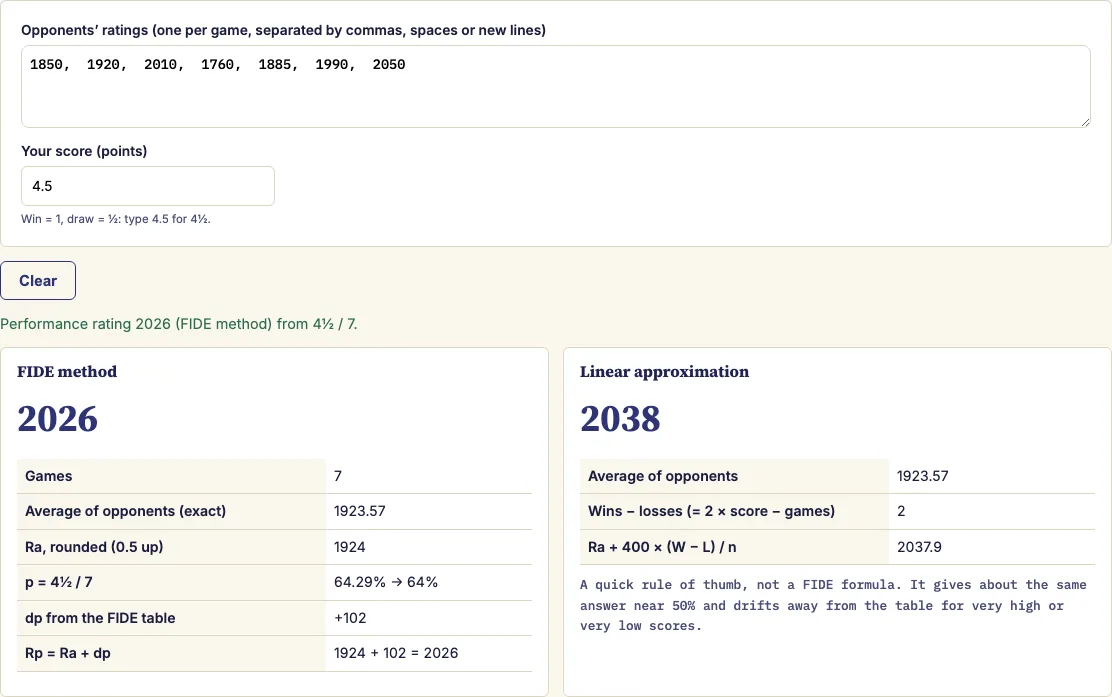
- Read the FIDE result: the rounded average rating of your opponents, your percentage score, the dp value from the table, and Rp = Ra + dp.
- Compare it with the linear approximation in the second box.
The full conversion table, from 0% to 100%, is built into the calculator, so you do not need to look anything up. Both results appear with their working, which helps you see where they differ and why.
The address bar keeps your numbers. Once the calculation is filled in, you can bookmark the page or copy the link to share it with a teammate or coach.
Check the list before you calculate. Enter only the games you actually played in that event, because the score and the ratings must describe the same games. If you list six opponents, the score should be out of six. A list that includes games outside the event will give a figure for a different set of results.
How is performance rating calculated?
The FIDE method uses Rp = Ra + dp. Ra is the average rating of your opponents, rounded to a whole number with 0.5 rounded up. dp is the rating difference read from the FIDE conversion table, using your percentage score rounded to a whole number, again with 0.5% rounded up. The table is the same one the FIDE Rating Regulations use for initial ratings.
Rounding can matter. 4½ out of 8 is 56.25%, and 5 out of 9 is 55.56%. Both round to 56%, so both use the 56% line of the table.
Many players also use a linear shortcut: average rating + 400 × (wins − losses) / games. It is easy to do in your head and close to the table for scores near 50%. At exactly 50%, both methods give the average rating of your opponents. However, the shortcut moves in straight steps while the table curves, so the two drift apart for very high or very low scores. With 3 out of 4 against an average of 1950, the table gives 2143 and the linear formula gives 2150. With 4 out of 4, they give 2750 and 2350.
What is a TPR in chess?
TPR stands for Tournament Performance Rating. The FIDE Tie-Break Regulations define it as the average rating of the opponents played over the board, plus the rating difference from the same conversion table, using the score from those games. Enter only the games you actually played in that event so the figure reflects those results.
The arithmetic works with any rating scale that uses the Elo model, such as a national rating. The FIDE rounding steps are applied in both cases.
What is a good performance rating?
A good performance rating is one above your own rating, because it means you played above the level your rating predicts. The useful comparison is with your own rating, not with a fixed number.
A performance number also has a formal use. The FIDE Title Regulations set a GM performance as at least 2600 against opponents averaging at least 2380, an IM performance as at least 2450 against at least 2230, a WGM performance as at least 2400 against at least 2180, and a WIM performance as at least 2250 against at least 2030, with a minimum score of 35%. A norm adds further conditions, including requirements on opponents' titles and federations, a minimum average rating of opponents, and rating floors. Treat the calculated number as a first check only.
Examples
Opponents 1800, 1900, 2000, 2100
Score 3 / 4 = 75.0% → 75%
FIDE: Ra 1950 +193 = 2143
Linear: 1950.0 + 400 × 2 / 4 = 2150.0
Opponents 1850, 1920, 2010, 1760, 1885, 1990, 2050
Score 4½ / 7 = 64.3% → 64%
FIDE: Ra 1924 +102 = 2026
Linear: 1923.6 + 400 × 2 / 7 = 2037.9
Opponents 1800, 1900, 2000, 2100
Score 4 / 4 = 100.0% → 100%
FIDE: Ra 1950 +800 = 2750
Linear: 1950.0 + 400 × 4 / 4 = 2350.0
Questions and answers
Can I use this for an employee performance rating?
No. This calculator takes opponents' Elo-style ratings and a game score as its inputs. Employee performance ratings use different measures, so the calculator will not give a meaningful figure for them.
What do I enter for a perfect or zero score?
Enter the points you actually scored, such as 4 for 4 out of 4. For a perfect or zero score there is no real rating difference, so the FIDE table lists +800 for a score of 1.0 and −800 for a score of 0, noting that the real value is indeterminate. The calculator uses those notional values and says so. For example, 4 out of 4 against opponents averaging 1950 gives 2750.
If I played the same opponent twice, do I enter their rating twice?
Yes. Every game counts separately, so enter that opponent's rating once for each game you played against them.
Which result should I use, the FIDE one or the linear one?
Use the FIDE result when you need a figure that follows the regulations. The linear figure is a mental-arithmetic shortcut, not a FIDE formula. When the two disagree, the FIDE result is the one to report.
Does this tool confirm a title norm?
No. The tool only calculates the performance. A title norm also depends on the opponents' titles and federations, the minimum average rating of opponents and rating floors, so check the FIDE Title Regulations for the full conditions.
Related chess tools
Updated