 ChessPuzzlePrint
Fool's Mate
Watch the two-move checkmate, then find the mating move yourself.
What this fool's mate page does
This free tool shows you fools mate, also called Fool's Mate, which is the shortest possible checkmate in chess. It runs in your web browser, requires no sign-up, and uploads nothing. You can watch the trap play out move by move, or test yourself by finding the checkmating move for Black.
Fool's Mate is a short trap that beginners often fall into, and it is worth knowing both how it works and how to avoid it. The board on this page checks every move with the chess.js library, so only legal moves are accepted. Use the tabs below the board to choose between a guided walkthrough and a practice position. Whether you are learning chess for the first time or revising for a club game, the tool gives you a clear, repeatable way to see the pattern.
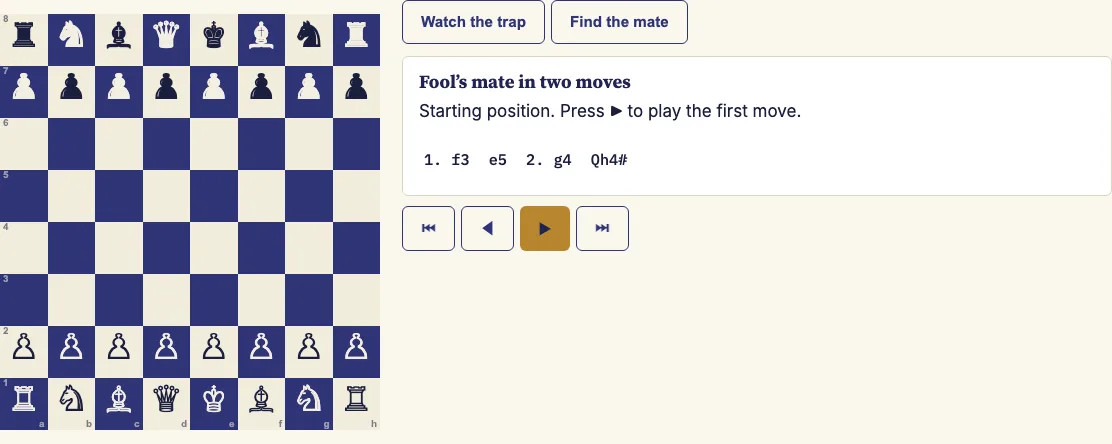
How to use the Fool's Mate tool
- Stay on the Watch the trap tab, which is the default. It plays the four half-moves of Fool's Mate, with a sentence explaining each one.
- Press ▶ (next move) to step forward one half-move at a time. Press ◀ (previous move) to step back.
- Press ⏮ (start) to return to the opening position, or ⏭ (last move) to jump to the checkmate.
- Open the list of moves under the board and click any move to go straight to it. Every move in the list is a button.
- Switch to the Find the mate tab. The game stops after 1. f3 e5 2. g4, and it is Black's turn.
- Click one of Black's pieces, such as the queen. Its legal squares are marked with dots.
- Click the square you want to move to. Find the one move that gives checkmate. Any other legal move shows a message that it is not checkmate.
- If you want to start the quiz again, press Try again. This resets the position.
- Press ⏭ to jump to the last position and see the checkmate at once, then use ◀ to step back through the moves.
- In the Find the mate tab, press Try again to go back to the position after 1. f3 e5 2. g4 and test another move.
What is the fastest checkmate in chess?
Fool's Mate, 1. f3 e5 2. g4 Qh4#, is the fastest checkmate possible, and it takes two moves each, which is four half-moves. No game can end in checkmate in three half-moves or fewer. The tool's tests searched every possible game up to three half-moves and found no checkmate.
A half-move is a single move by one side. White moves first, so the shortest mate must come on Black's second move. Even then, the mating side needs both its moves to be efficient, and White's first two moves have to open the position for Black's queen. Checkmate needs the king to be attacked and unable to escape, block, or capture the attacker, and that is hard to arrange in so few moves.
Why does Fool's Mate work?
White's f-pawn and g-pawn both move, which opens the diagonal from h4 to e1. Black's queen then travels to h4 and gives check to the king, and White has no way to stop it.
The diagonal runs h4, g3, f2, e1. The f-pawn normally sits on f2 and blocks it, but after 1. f3 it has left. After 2. g4, nothing can reach g3 to block the check, and nothing can reach f2 either. The king on e1 has no square to step to. Its own pieces surround it: the queen on d1, the bishop on f1 and the pawn on e2 all stand in the way. Checkmate is therefore complete, not just check.
The same idea works in other orders. After 1. g4 e5 2. f3, after 1. f3 e6 2. g4, and after 1. g4 e6 2. f3, Black also has Qh4#. In each case White has pushed both the f-pawn and the g-pawn, and the black queen reaches h4 with check.
Examples
Questions and answers
What are the moves of Fool's Mate?
The moves are 1. f3 e5 2. g4 Qh4#. White plays the f-pawn and then the g-pawn, Black plays e5 and then queen to h4. Black's second move gives checkmate, so the game ends after four half-moves.
Can Fool's Mate happen with other moves?
Yes. The mate can also arise after 1. g4 e5 2. f3, after 1. f3 e6 2. g4, and after 1. g4 e6 2. f3. In each of these, White has moved both the f-pawn and the g-pawn, and Black's queen reaches h4 with check.
How do you avoid Fool's Mate?
As White, do not open the diagonal from h4 to e1 while your king is still on e1. The f-pawn on f2 is the piece that normally blocks this diagonal. As Black, you can look for this pattern when White has pushed both the f- and g-pawns early.
Can I practise Fool's Mate on the board?
Yes. Open the Find the mate tab, which stops after 1. f3 e5 2. g4. Click the queen, then click h4 to see if you have found the checkmate.
Is Fool's Mate the same as Scholar's mate?
No. Fool's Mate is the shortest possible checkmate and needs only four half-moves. Scholar's mate is a different pattern that takes longer, and it is covered on its own page.
Related chess tools
Open-source components used by this tool: chess.js (BSD-2-Clause).
Updated