 ChessPuzzlePrint
FIDE Rating Calculator
Enter your FIDE rating and your games, and see the rating change exactly as the FIDE Rating Regulations describe it — or calculate a first rating for an unrated player.
What the FIDE rating calculator works out
The FIDE rating calculator works out a rating change for a rated player, or a first rating for an unrated player, from the games you enter. It follows the steps in FIDE's Rating Regulations and shows every number, so you can check each line of the result. The calculator runs in your browser. It only does the arithmetic and does not look up ratings or send anything anywhere, so you type in your own rating and your opponents' ratings. Choose the rating list first, because standard, rapid and blitz follow slightly different rules for large rating gaps. Use the tool to check a rating period's result or to estimate a first rating from your games.
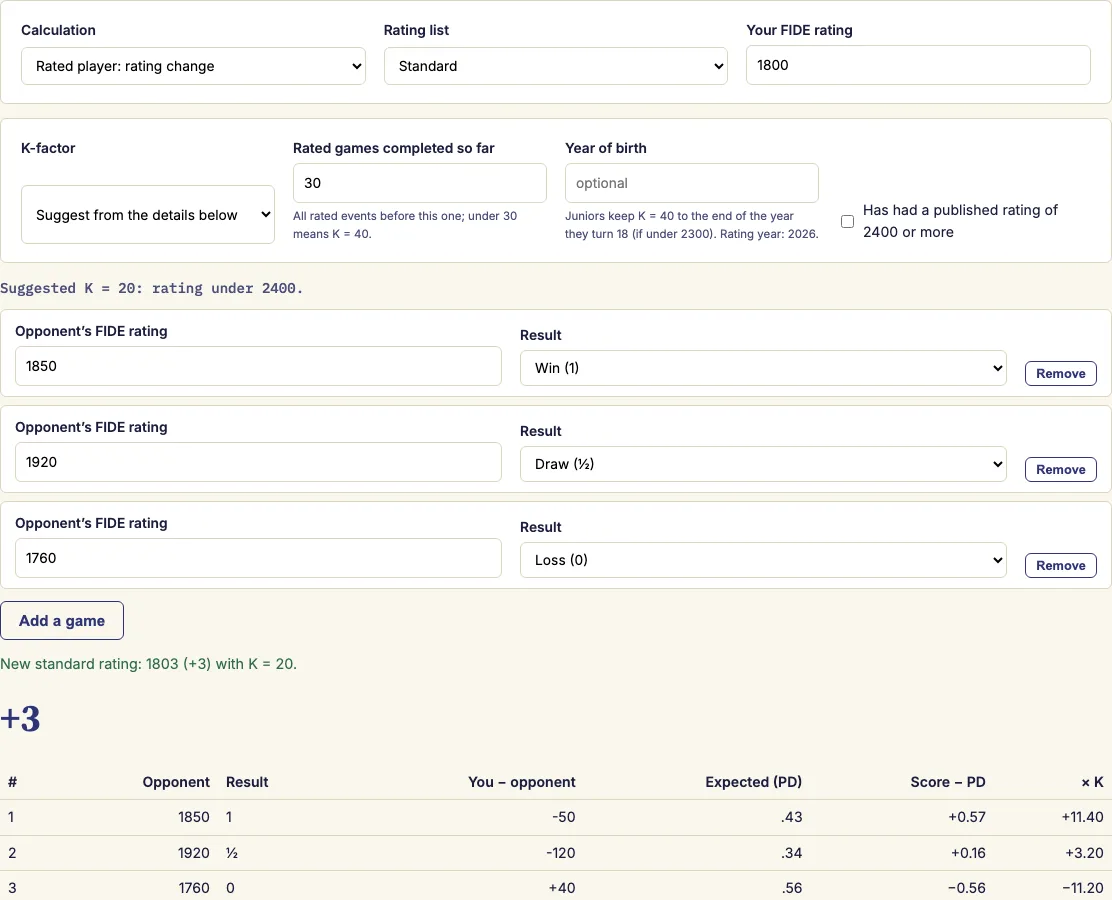
How to use the FIDE rating calculator
- Choose "Rated player" for a rating change or "Unrated player" for a first rating, and pick the rating list: standard, rapid or blitz.
- Type your current FIDE rating. Leave the K-factor on "Suggest" and fill in how many rated games you have completed, your year of birth and whether you have ever had a published rating of 2400. Or choose K yourself.
- For each game, enter the opponent's FIDE rating and the result. Click "Add a game" for every rated game in the same rating period.
- Read the table. It shows the rating difference used, the expected score from the FIDE table, the score minus the expected score, and that value times K.
- The large number is the rounded rating change. The line under the table shows the exact sum before rounding and your new rating.
Enter all games of the rating period together rather than adding up separately rounded tournaments. Leave out forfeits and other unplayed games, because they are not rated. Only games against rated opponents count towards a rated player's change.
Have the official rating list open in another tab while you work. Nothing is looked up for you, so copy each opponent's rating exactly as it appears.
How is the FIDE rating calculated?
FIDE does not use the smooth Elo curve directly. Instead, its Rating Regulations give a table that turns each rating difference into an expected score with two decimals. For every game against a rated opponent, FIDE looks up the expected score PD for the difference in table 8.1.2, subtracts it from the result (1, ½ or 0), and adds these differences across the rating period.
The rating change is K multiplied by that sum, rounded to the nearest whole number, with 0.5 rounded away from zero. The table rounds probabilities to two decimals, so it can differ slightly from the exact formula. For a 200-point difference, the table gives .76 for the higher-rated player, while the formula gives 0.7597. Over many games, such small differences can move the rounded result by a point.
Rounding applies to the total for the whole rating period. If K multiplied by the number of games would be more than 700, FIDE lowers K to the largest whole number that keeps the product at 700 or less. The calculator does this automatically and tells you.
How does FIDE rating work?
FIDE publishes a new list on the first day of every month, and ratings are updated for each rating period. Standard, rapid and blitz are separate lists. Rapid and blitz use the same K values as standard, but they handle large rating gaps differently.
In standard chess, a difference above 400 points counts as 400 only for players rated below 2650. Since 1 October 2025, players rated 2650 and above use the real difference. In rapid and blitz, every difference above 400 counts as 400. Since 1 December 2024, a game is not rated if the difference is 600 points or more and at least one player is rated above 2600.
An unrated player gets a first rating instead. FIDE needs at least 5 games against rated opponents, which can come from several events within 26 months, and it pools them. Two hypothetical opponents rated 1800 are added, each with a draw. Ra is the average rating of all these opponents, and the first rating is Ra plus dp from the conversion table, rounded to a whole number. The result is at most 2200. A zero score in the first event is disregarded.
Examples
Standard, rating 1800, K = 20
1850: 1  PD .43  +0.57
1920: ½  PD .34  +0.16
1760: 0  PD .56  −0.56
Σ = +0.17 × 20 = +3.40
Rating change +3 → 1803
Standard, win against a player 500 points lower
2000 (K = 20) beats 1500:
  difference counted as 400, PD .92, change +2
2700 (K = 10) beats 2200:
  real difference 500, PD .96, change +0
Unrated player, 5 games, score 3
Opponents 1600, 1700, 1800, 1900, 2000
+ two 1800s, drawn: 4 / 7
Ra 1800, p 57%, dp +50
First rating 1850
Questions and answers
What is a good FIDE rating?
A FIDE rating measures playing strength compared with other rated players, so there is no fixed number that counts as good. The expected score table shows how much a gap matters: a 200-point difference gives the higher-rated player an expected score of about .76.
Can you get a FIDE rating online?
This calculator does not register you or publish a rating. It works out a first rating from your games using FIDE's steps, provided you have at least five games against rated opponents within 26 months. A rating that appears on FIDE's official list comes from FIDE, not from this page.
What K-factor do I have?
Your K depends on your age, how many rated games you have completed and your highest published rating. K is 40 for a new player until they complete events with at least 30 games, and for everyone until the end of the year of their 18th birthday while their rating stays under 2300. It is 20 while the rating is under 2400, and 10 once a published rating has reached 2400, even if it drops later.
Does the calculator look up ratings?
No. It only does the arithmetic in your browser and does not send anything anywhere. The figures you type are the only data it uses.
Why is my first rating not published?
FIDE does not publish a first rating below 1400, so a result under that figure will not appear on the list. First ratings are also capped at 2200. If you have fewer than five games against rated opponents, a first rating cannot be worked out.
Can I use it for rapid or blitz?
Yes. Choose rapid or blitz when you pick the rating list. The K values are the same as for standard. If you already hold a standard rating, a first rapid or blitz rating starts from that rating.
Related chess tools
Updated