 ChessPuzzlePrint
En Passant
Practise the en passant capture on a real board, test yourself with a quiz or paste a position to find the capture.
What this en passant tool does
En passant is a special pawn capture in chess. When a pawn moves two squares from its starting square and lands directly beside an enemy pawn, that enemy pawn may capture it as if it had moved only one square. The capture is allowed for one move only, the move straight after the two-square advance.
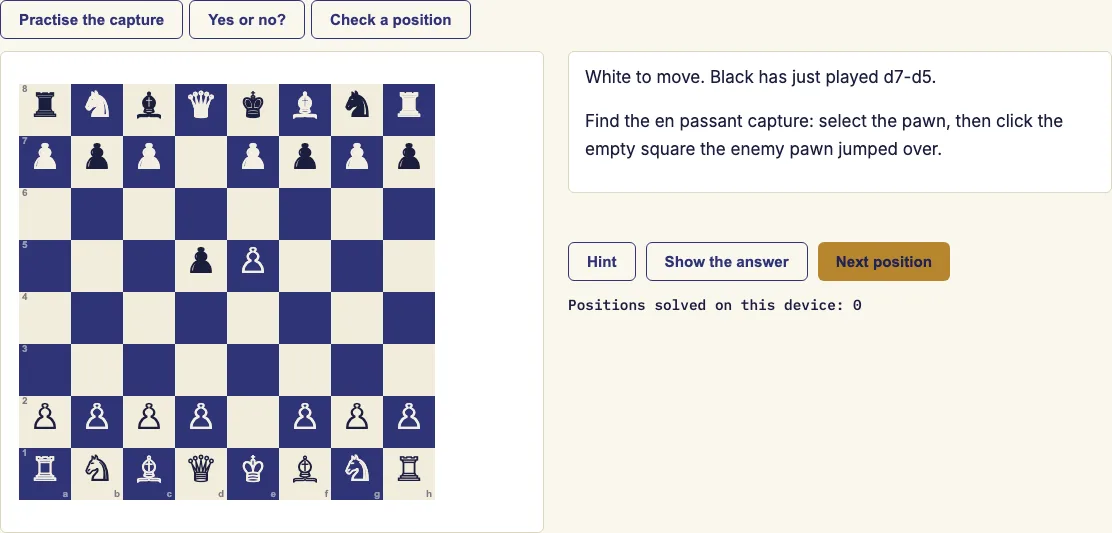
This tool lets you learn the rule by doing it. In Practise the capture you play the en passant capture in six positions. In Yes or no? you decide whether en passant is available in nine positions, including the awkward ones where the capture would expose your own king. In Check a position you paste any FEN and it lists every legal en passant capture.
The rules come from a standard chess engine library and run in your browser.
How to practise en passant
To practise the capture:
- Open Practise the capture and read the line above the board, which tells you which pawn has just moved two squares.
- Click your pawn that stands beside it on the fifth rank (the fourth rank if you are Black). Its legal squares are marked.
- Click the empty square diagonally ahead, the square the enemy pawn skipped over. The tool says whether that was an en passant capture and removes the captured pawn.
- Use Hint if you are stuck, Show the answer to see the move, and Next position to continue.
- If you click a different legal move, the tool tells you it is legal but not en passant, so you can try again. Positions you solve are counted on this device only.
- Two positions are played by Black. The board turns around so that the side to move is always at the bottom, and the line above the board says who has just moved.
To test your judgement, open Yes or no?, answer Yes or No and read the explanation. To analyse your own game, open Check a position, paste a FEN with the en passant square in the fourth field (for example d6) and press Find en passant.
What is en passant in chess?
En passant is French for "in passing". It exists because a pawn can move two squares on its first move; without the rule, a pawn on its fifth rank could be passed safely by an enemy pawn and never be captured. FIDE Article 3.7 (Laws in force from 1 January 2023) describes it exactly like that: the capturing pawn takes the other pawn as though it had moved only one square, and the capture is legal only on the move following the advance.
In practice this means three conditions at the same time:
- The enemy pawn has just moved two squares from its starting square, on the previous move.
- Your pawn stands on the same rank, on a neighbouring file. For White that is the fifth rank, for Black the fourth.
- The capture does not leave your own king in check.
How does the en passant capture work on the board?
Your pawn does not land on the square of the pawn it captures. It moves one square diagonally forward onto the square the enemy pawn passed over, and the enemy pawn is removed from the board. After 1.e4 and ...d5 followed by e5 and ...f5, for example, White plays exf6 e.p. and the black pawn on f5 disappears.
In a FEN the en passant target square is the fourth field. It is a dash when no capture is possible. The tool reads that field, and its Check a position tab lists only captures that are actually legal.
When can you not capture en passant?
You cannot capture if you wait a move: the right disappears if you play anything else first. You cannot capture a pawn that moved one square at a time, a piece that is not a pawn, or a pawn that is two files away. And you cannot capture if doing so opens a line to your king. The yes-or-no quiz includes an example where a rook on the fifth rank makes the capture illegal, because removing both pawns opens the rank to the king.
Examples
Questions and answers
Is en passant forced?
No. En passant is optional, like any other capture. If you do not take on the next move, the right to take is gone for good.
Can you capture en passant with any piece?
No. Only a pawn can capture en passant, and only a pawn can be captured that way.
Can you capture en passant to get out of check?
Yes, when the pawn that gives check is the one that has just made the two-square move. The practice set includes this case: Black answers a check from a pawn on d4 with exd3 e.p.
Does en passant work for both colours?
Yes. White captures from the fifth rank and Black from the fourth. The tool turns the board so that the side to move is at the bottom.
How is en passant written in notation?
As a normal pawn capture, such as exd6, and sometimes with "e.p." added.
Why does the tool say the FEN names a square but there is no capture?
A FEN may record the square behind any pawn that moved two squares, even if no enemy pawn can use it. The checker then tells you the capture is not possible and why.
Related chess tools
Open-source components used by this tool: chess.js (BSD-2-Clause); ChessPieces font (Noto Sans Symbols 2 subset) (SIL OFL 1.1).
Updated