 ChessPuzzlePrint
Chess Elo Calculator
Enter your rating, your opponents and your results, and see exactly how many Elo points each game is worth.
What the Elo calculator works out
The Elo calculator works out how much your chess rating changes after a single game or a whole event. You enter your current rating, choose a K-factor, and add each opponent's rating and result, and it shows the expected score for each game, the change it causes and the total. The calculation runs entirely in your browser. It also shows the expected score, a probability-like number between 0 and 1 for each game. Add as many games as the event had. This page explains the Elo chess rating system, the formula behind the calculator and the choices that affect your result.
How to use the Elo calculator
- Type your current rating into the field for your rating.
- Choose your K-factor from the list, or type your own value. Pick the one your rating is calculated with.
- For each game, enter the opponent's rating and select the result: win, draw or loss. A win scores 1, a draw ½ and a loss 0.
- If your federation counts rating gaps above 400 as 400, as FIDE does, tick the 400-point option.
- Read the total change and your new rating. The table shows how each game contributed.
For a whole tournament, use "Add a game" once for every round you played. Each change is calculated from your rating before the event, so you do not need to update the rating between games.
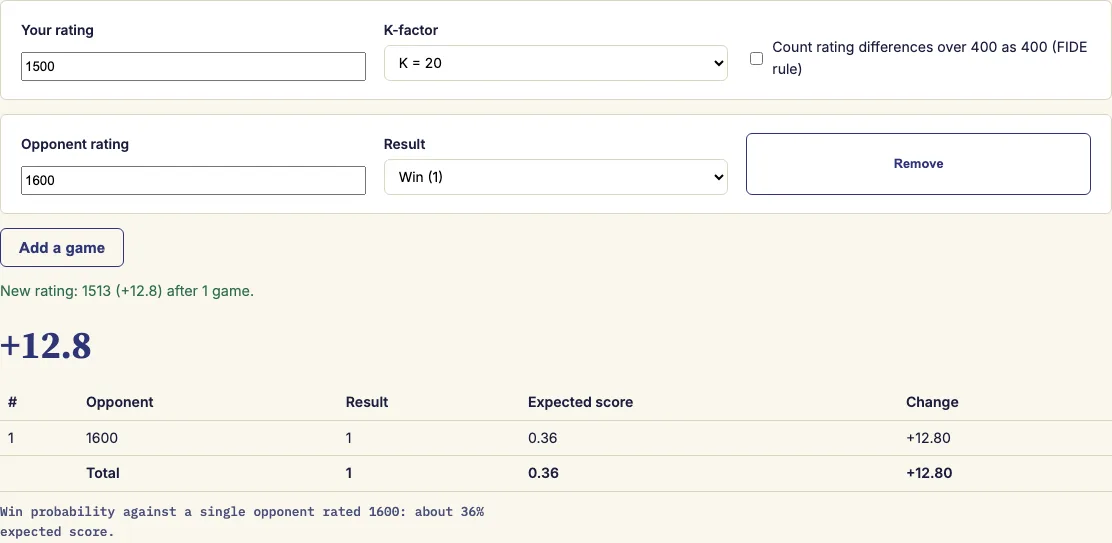
Here is a short example. Suppose you are rated 1500, your K-factor is 20 and you beat a 1600-rated player. The expected score is about 0.36, so the win adds roughly 13 points (20 × (1 − 0.36) = 12.8). The table shows that single game, and the total change is shown next to your new rating.
Federations round the result, may use special rules for new players, and some use a different system altogether. Check your official rating change against the rules your federation applies, because this calculator gives the plain Elo result.
How is chess Elo calculated?
The Elo system predicts a score for each game from the rating difference between the two players. It then moves your rating by the gap between that prediction and the result, where a win counts as 1, a draw as ½ and a loss as 0.
The expected score is found with this formula:
E = 1 / (1 + 10^((Rb − Ra) / 400))
Here Ra is your rating and Rb is your opponent's. The result is a number between 0 and 1. An expected score of 0.76 means you are expected to score about three points in four games against that opponent.
Your rating then changes by:
Change = K × (actual score − E)
As a worked example, take two players rated 1500 with a K-factor of 20. Their expected score is 0.5. A win gives 20 × (1 − 0.5) = +10, a loss gives −10 and a draw gives 0.
Beating a stronger player gains you more than beating a weaker one, and losing to a weaker player costs you more. A draw follows the same logic: it gains points against a much stronger opponent and costs points against a much weaker one. A 400-point gap gives the stronger player an expected score of about 0.91.
For a tournament, each game's change is calculated from your rating before the event, and the changes are added together. Under FIDE rules, a rating difference larger than 400 is counted as exactly 400. This limits how little you can gain or how much you can lose against a much lower-rated player.
What is an Elo rating?
An Elo rating is a number that estimates your playing strength compared with other rated players. Predictions depend on the difference between two ratings, not on the numbers themselves.
The system is named after Arpad Elo, a physics professor. The US Chess Federation adopted it in 1960 and FIDE adopted it in 1970. Your rating moves after every rated game, so it reflects your recent results over time. A higher rating means you are expected to score more often against lower-rated players, but the number is an estimate built from results, not a fixed measure of skill.
Examples
Rating 1500, K = 20
Win against 1700
Expected score 0.24
Change +15.2 → 1515.2
Rating 1800, K = 20
Draw against 1600
Expected score 0.76
Change −5.2 → 1794.8
Rating 1450, K = 40, four games
1500: 1 (+22.9)
1620: ½ (+9.1)
1390: 0 (−23.4)
1555: 1 (+25.9)
Total +34.4 → 1484.4
Questions and answers
What is considered a good chess Elo?
There is no single good number, because a rating only means something compared with the players you face. Under FIDE, titles are tied to rating levels: 2300 for FIDE Master, 2400 for International Master and 2500 for Grandmaster, alongside other title requirements.
What K-factor should I use?
Use the K-factor that your federation or site applies to you. FIDE uses 40 for new players and juniors under 2300, 20 for players under 2400 and 10 once a player has reached 2400. Other federations and websites set their own K values.
Why don't my online chess ratings match this calculator?
Online chess platforms often use other systems, such as Glicko, so their numbers will not match this calculator exactly. This tool shows only the plain Elo calculation.
Does a draw change my rating?
Yes. A draw counts as ½ in the formula. Against a much stronger opponent, a draw gains you points, and against a much weaker one, it costs you points.
What does the expected score tell me?
It is the share of points the formula predicts you will score against that opponent, between 0 and 1. A value near 0.5 means the two players are evenly matched. It is a prediction rather than a guarantee, so upsets happen, and they cause larger rating changes.
Related chess tools
Updated