 ChessPuzzlePrint
Chess ECO Codes List
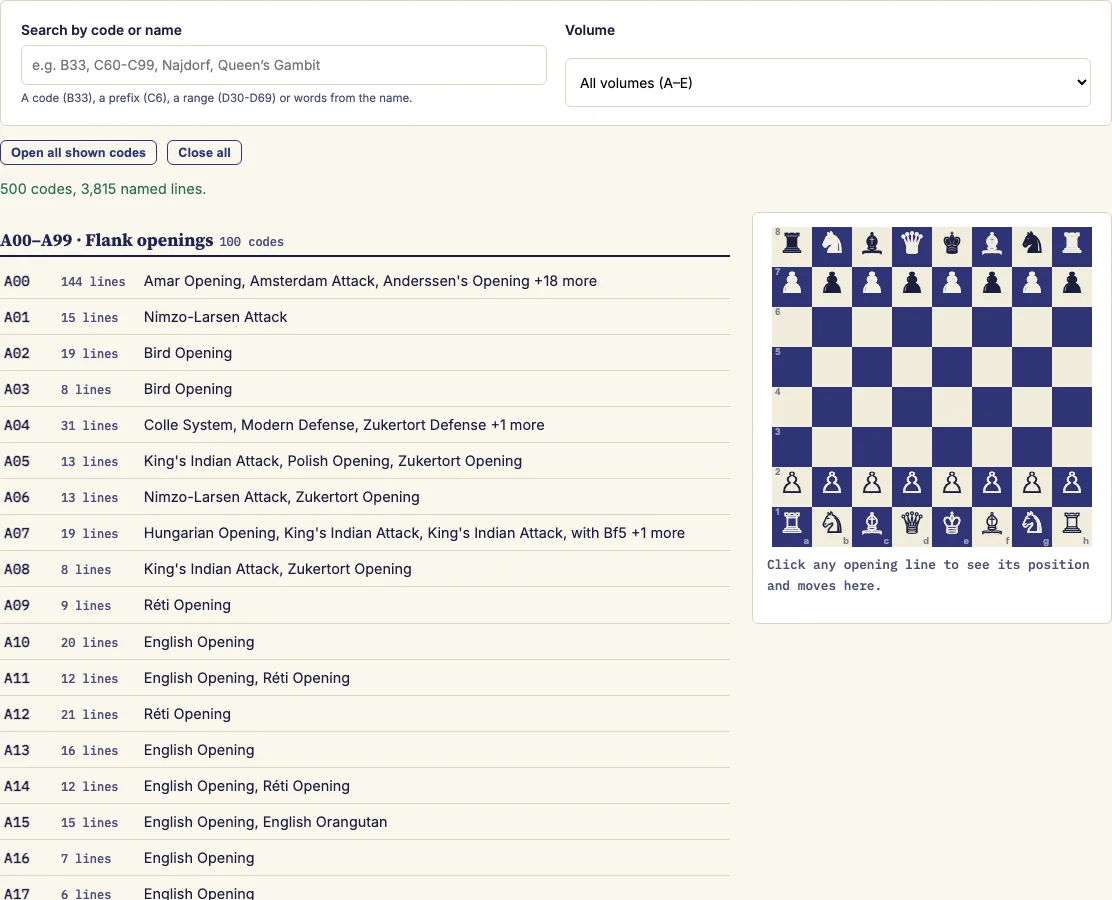
All 500 ECO codes with the named opening lines filed under each one. Search, open a code and click a line to see its position.
What are ECO codes?
The ECO codes list files 3,815 named chess opening lines under their ECO codes, from A00 to E99. Each code shows how many lines it holds and which openings they belong to, so you can take an opening label from a book or magazine and see its moves.
The list covers all five volumes, A to E. You can scroll through them or pick one in the Volume menu. Open a code to see every line with its moves, then click a line to view the position it reaches on the board.
Use it to study one opening family in order, compare named variations that share a code, or check the code for an opening you have just read about.
How to use the ECO codes list
- Choose a volume. Scroll through the five volumes, or pick one in the Volume menu.
- Search by code. Type a full code such as B33, the start of a code such as C6 (for C60–C69), or a range such as D30-D69.
- Search by name. Type words from an opening name, such as Najdorf or Queen's Gambit, or just part of one.
- Open a code. Click it to list its named lines with their moves. To open every code in the current list at once, use "Open all shown codes".
- Click a line. The preview panel shows the final position, the moves and the FEN.
- Continue in the opening finder. Follow "Open in the opening finder" to play on from that position and see which named moves come next.
Name searches match the start of words and ignore accents, so "reti" finds Réti lines and "kings indian" finds King's Indian lines. An opening can also appear under several codes: the Sicilian Defence, for example, fills most of B20 to B99, so check each code that comes up.
The link in the address bar keeps your search, the selected volume and the selected line. Bookmark it or share it to return to the same view.
What are ECO codes in chess?
ECO codes are the classification used by the Encyclopaedia of Chess Openings, a reference work published by Chess Informant. It sorts openings into 500 codes, from A00 to E99, grouped into five volumes of 100 codes each.
A code names a family of positions, not one exact line. Most codes hold several named variations, such as different sixth moves in the same system. These share the code but have their own names. Books and game collections use the code as a short label, so B20 means the Sicilian Defence.
What do the letters A to E mean?
Each letter is a volume covering a broad group of openings:
The London System (1.d4 d5 2.Bf4) starts with 1.d4 d5, so it falls in the D volume.
- A: flank openings such as the English and the Réti, other unusual first moves, and some 1.d4 defences such as the Dutch, the Benoni and the Benko Gambit.
- B: 1.e4 openings where Black answers with a move other than 1...e5 or 1...e6, such as the Sicilian, Caro-Kann and Pirc.
- C: open games, 1.e4 e5, and the French Defence.
- D: closed and semi-closed games, including 1.d4 d5 lines such as the Queen's Gambit and the Grünfeld.
- E: Indian defences after 1.d4 Nf6 2.c4 e6 or g6, such as the Nimzo-Indian, Queen's Indian and King's Indian.
Where can I find a chess opening list?
The ECO codes list on this page is one. It files 3,815 named lines under their codes, with counts of A 817, B 772, C 1250, D 614 and E 362.
To find one opening, search by its name. To study a whole family in order, search a code range, such as C60-C99 for the Ruy Lopez.
How do I find the ECO code of my game?
Paste the moves into the opening finder. It names the deepest position your game reached and shows its ECO code. Then search that code here to see the named lines that share it.
Examples
B20 — 27 named lines
Sicilian Defense
  1. e4 c5
Sicilian Defense: Amazon Attack
  1. e4 c5 2. Qg4
Sicilian Defense: Big Clamp Formation
  1. e4 c5 2. d3 Nc6 3. c3 d6 4. f4
Sicilian Defense: Bowdler Attack
  1. e4 c5 2. Bc4
Sicilian Defense: Brick Variation
  1. e4 c5 2. Nh3
Sicilian Defense: Czerniak Attack
  1. e4 c5 2. b3
… and 21 more
Questions and answers
Where do I find the London System ECO code?
Type "london system" in the name search, then open the code it leads to. Its named lines are listed with their moves, and clicking a line shows the final position and its FEN.
Will I see the moves for each opening?
Yes. Open a code to see its named lines with their moves, and click a line to see the final position and its FEN.
Can I search by a range of codes?
Yes. Type a range such as D30-D69, or the start of a code such as C6 to list C60 to C69. A range is useful for studying one family in order.
Does the search need accents?
No. Accents are ignored, so "reti" finds Réti lines and "kings indian" finds King's Indian lines, so you can type names without accent marks.
Does the address bar link save my view?
It keeps your search, the selected volume and the selected line. Bookmark the link or share it to return to the same view later.
Why might two sources give different codes for one opening?
Most programs and collections use the same 500 codes. However, the exact line where one code ends and the next begins can differ slightly between sources, especially for rare openings.
Related chess tools
Open-source components used by this tool: chess.js (BSD-2-Clause); chess-openings catalogue (CC0-1.0).
Updated