 ChessPuzzlePrint
Chess960 Position Generator
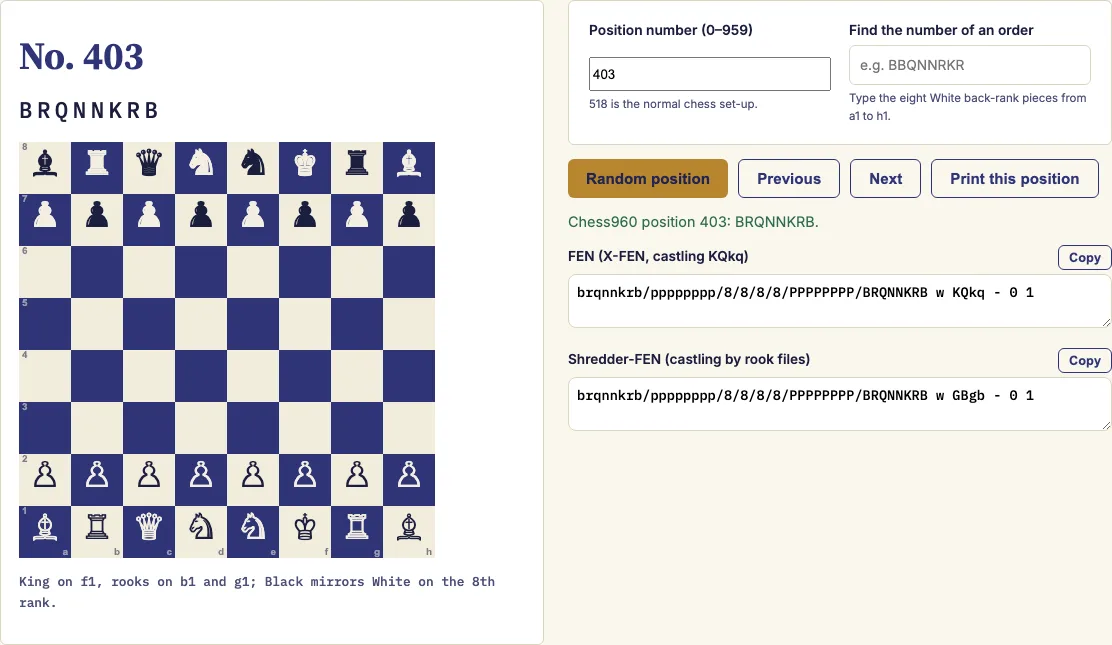
One click gives you a fresh Fischer Random set-up, with its standard number, the board and a FEN.
What is Chess960?
Chess960, also called Fischer Random chess, is a form of chess in which the pieces on the back rank are shuffled before the game starts. The Chess960 position generator on this page gives you one of its 960 starting positions, either picked at random or chosen by number.
Each position comes with a board, its piece order and a FEN that you can paste into a chess program that supports Chess960. You can also print the set-up for a club or tournament round. If you want a new opening every game, or you need a chess 960 generator that works from a single number, this page covers both.
How to use the Chess960 position generator
- Press Random position to draw one of the 960 set-ups, or type a number from 0 to 959 in the number field.
- Press Previous or Next to step through the numbers one at a time.
- To find the number of a set-up you already have, type its eight White back-rank pieces from a1 to h1, for example BBQNNRKR.
- Copy the FEN. If your program expects castling rights written as rook files, copy the Shredder-FEN instead.
- Press Print this position to print the board and the piece order for the players.
Each press of Random position picks a whole number from 0 to 959 with your browser's random number generator, so every position has the same chance of coming up.
The eight letters in step 3 are the White back-rank pieces from a1 to h1, in order: B for bishop, Q for queen, N for knight, R for rook and K for king. Read them from a1 on the left to h1 on the right, so BBQNNRKR has bishops on a1 and b1 and the king on g1. Black's pieces mirror them on rank 8.
The address bar keeps the number as ?n=, so a link opens the same position for everyone in your club. Share that link when you want the whole group to start from one set-up. The positions and printouts you make here are free to use at your club or in products you sell, such as booklets or KDP books.
What are the chess 960 rules?
Chess960 uses the normal rules of chess, but the back-rank pieces are arranged differently before the game begins. Pawns stay on the second rank, and Black's pieces mirror White's. Two conditions control the shuffle: the bishops must stand on squares of opposite colours, and the king must stand somewhere between the two rooks, so that castling is still possible.
The usual numbering scheme builds each set-up in steps. It takes the light-squared bishop's file from the remainder after dividing the number by 4, and the dark-squared bishop's file from the next division by 4. The queen's square comes from a division by 6. The two knights then take one of ten possible pairs of the remaining five squares. The last three squares take rook, king, rook in that order, which keeps the king between the rooks.
Who invented Chess960?
Bobby Fischer proposed Chess960 in 1996, which is why it is also called Fischer Random chess. Apart from the shuffled start and the castling rules described below, all other rules are the same as normal chess.
How does castling work in Chess 960?
Castling in Chess960 follows the same idea as in normal chess, but the king and rook start on different squares. After castling, the king and rook end on the same squares as in the standard game: the king on g1 and the rook on f1 for the short side, and the king on c1 and the rook on d1 for the long side. Black does the same on rank 8.
All squares between the king and rook, and their destination squares, must be empty apart from those two pieces. The king may not be in check, pass through check or land in check, and neither piece may have moved before. If the king or a rook already stands on its destination, castling still works, as long as the other squares it needs are clear.
Examples
Questions and answers
How many starting positions are there in Chess960?
There are exactly 960. Each bishop has 4 possible squares, the queen has 6, and the knights have 10 possible pairs, while the rooks and king fill the last three squares. That gives 4 × 4 × 6 × 10 = 960.
Which number is the normal chess set-up in this generator?
Number 518 is RNBQKBNR, the ordinary chess starting position. Number 0 is BBQNNRKR.
Can I play Chess960 online?
This page shows and prints the set-up, but it does not host the game itself. Paste the FEN into any chess program that supports Chess960 to play it there.
Does Chess960 change how the pieces move?
No. All other rules are the same as normal chess, so each piece moves as it does in the standard game. Only the starting arrangement and the castling rules described above are different.
Why does the generator give a Shredder-FEN as well as a FEN?
The FEN writes castling rights as KQkq, meaning the outermost rook on each side. This is unambiguous at the start because each side has only one rook per wing. The Shredder-FEN writes the rook files instead, such as HAha, which leaves no doubt about which rook may castle.
How do I play a fair match from one position?
Play two games with the same start position and swap colours. This way each player has the white pieces once from the same set-up.
Can I use the Chess960 positions and printouts for commercial use, like a tournament booklet or a KDP book?
Yes. The positions and printed sheets you make are royalty-free for personal, club and commercial use, including KDP books, Etsy printables and event booklets you sell. No credit is required, and the only thing you may not do is copy this generator itself to run a competing service.
Related chess tools
Open-source components used by this tool: ChessPieces font (Noto Sans Symbols 2 subset) (SIL OFL 1.1).
Updated