 ChessPuzzlePrint
Buchholz Calculator and Chess Tiebreaks
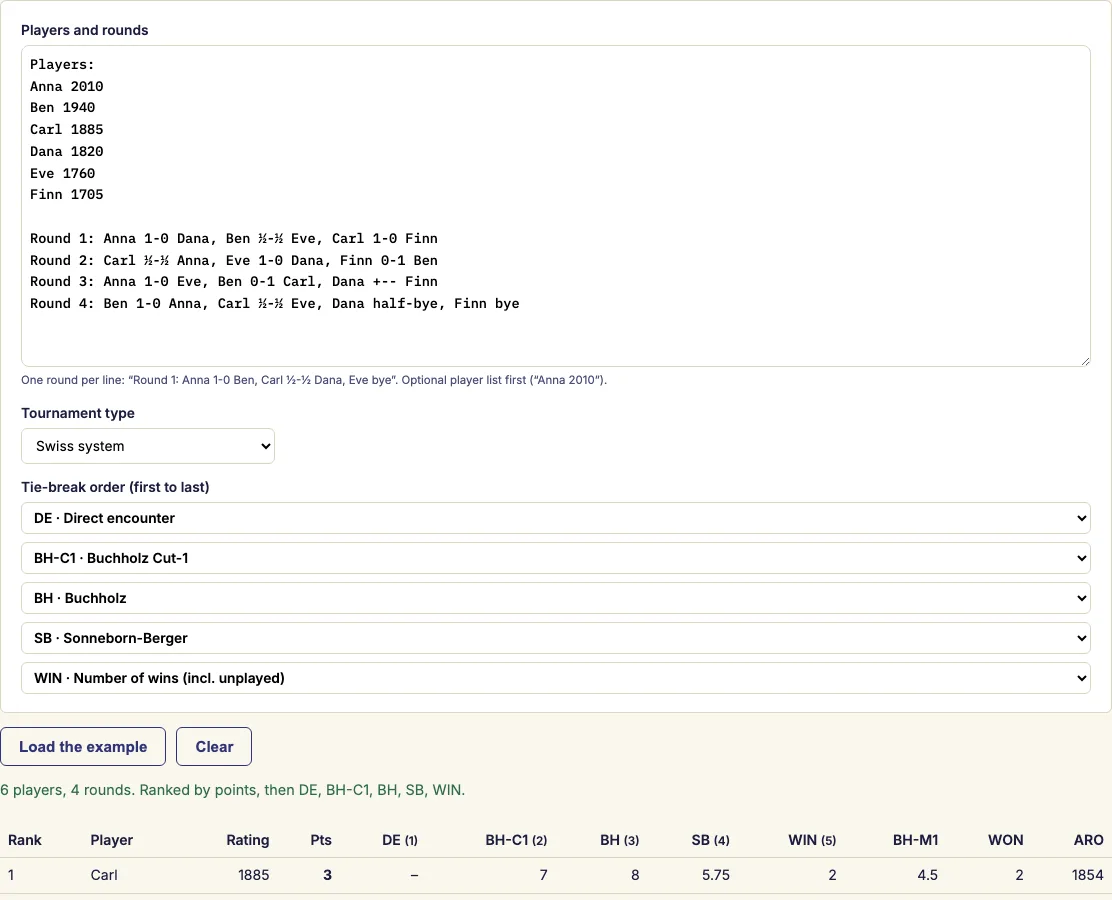
Write each round as a line of results — “Round 1: Anna 1-0 Ben, Carl ½-½ Dana, Eve bye” — and the calculator ranks the players with the FIDE tie-breaks in the order you choose.
What the Buchholz calculator does
The Buchholz and tie-break calculator on this page works out Buchholz scores and the other main FIDE tie-breaks for players who finish on the same points. It is free and runs in your browser. Enter your results round by round, and the standings update as you type, so you can see who is ahead under the tie-break order you choose. It covers Swiss events and round robins, and it offers Buchholz-type tie-breaks only for Swiss events. It handles unplayed rounds, byes and forfeits under the FIDE regulations and lists every adjustment it made, round by round. Use it when your tournament rules rank players by a list of tie-breaks applied one after another.
How to use the Buchholz and tie-break calculator
- Optionally, list the players first, one per line with their rating, for example "Anna 2010". If you use a list, every name in the rounds must match it. Without one, players are taken from the rounds.
- Write each round on its own line starting with "Round 1:", then the games separated by commas, for example "Anna 1-0 Ben, Carl ½-½ Dana". "1/2-1/2" also works. White is written first.
- Mark a forfeit with "+--" (first player wins) or "--+" (second player wins).
- Mark a pairing-allocated bye with "Eve bye", which is worth a full win, or write "Eve bye ½" for a half-point bye.
- Mark a requested bye with "half-bye" or "zero-bye". A player missing from a round gets a zero-point bye.
- Choose Swiss or round robin.
- Set the tie-break order to match your tournament regulations.
- Check the standings, which update as you type.
- Copy the standings as plain text from the box under the table, or open the list of unplayed-round adjustments to check them.
Your text stays in this browser, so you can add each new round as the tournament goes on. Enter only the results that count for the standings. Check the unplayed-round adjustments after each update, because unplayed rounds are where tie-break calculations most often disagree.
How is the Buchholz score calculated?
The Buchholz score of a player is the sum of the scores of that player's opponents. In Swiss events, unplayed rounds count as games against a dummy opponent. For the player's own Buchholz, a bye or forfeit uses a dummy whose score is the player's own score, capped at the scheduled opponent's score for forfeits and at half the number of rounds for byes. The calculator applies these rules automatically, following Article 16 of the FIDE Tie-Break Regulations.
What is Buchholz Cut 1?
Buchholz Cut-1 is the Buchholz score with the lowest of the opponents' values left out. Under FIDE Article 16.5, a player who has a requested bye or a forfeit loss has the lowest value from that round cut first, so the calculator removes that value before the others. Median Buchholz (Median-1) goes one step further and leaves out both the lowest and the highest values.
What is Sonneborn-Berger?
Sonneborn-Berger is a tie-break that gives more weight to results against stronger opponents. For each round, multiply the opponent's final score by the points you scored against them, then add the products. A win counts the opponent's full score, a draw half of it, and a loss nothing. Unplayed rounds are handled with the same dummy-opponent rule that applies to Buchholz.
Which tie-break comes first?
The tie-break order comes from your tournament regulations, which list the tie-breaks to apply one after another. If the regulations do not give an order, FIDE leaves the choice to the Chief Arbiter, who must publish it before the tournament starts. The calculator does not pick a default order for you; you set it in the tool.
When your regulations use direct encounter, the results of the tied players against each other form a separate table. If all of them have met, that table ranks them, and any remaining ties are checked again within the smaller group. In a Swiss event where not all have met, a player ranks first only if they would stay alone on top whatever the missing games had produced. If two players met more than once, the average of those games is used. In Swiss events, forfeits are left out of this comparison unless the tournament rules include them.
Examples
Rank  Name  Rating  Pts  DE  BH-C1  BH   SB
1     Carl  1885    3    –   7      8    5.75
2     Ben   1940    2½   1   7.5    8.5  4.5
3     Anna  2010    2½   0   7.5    9    5
4     Eve   1760    2    –   8      9.5  4.25
5     Dana  1820    1½   –   5.5    7    1.75
6     Finn  1705    1    –   6.5    7.5  1
C: forfeit win in round 2, half-point bye in round 3
Buchholz 8, Cut-1 6 (the bye is cut, not the lower forfeit value)
F: withdrew after round 2
score 0, counted as 1 in opponents’ tie-breaks
Rank  Name  Pts  DE   SB    KS
1     Cat   2    0.5  2.75  1.5
2     Ben   2    0.5  2.25  1
3     Ann   1½   –    1.5   0.5
4     Dev   ½    –    1     0.5
Questions and answers
Can I use the Buchholz calculator for a round robin?
No. Buchholz and its variants must not be used in round robins, so the calculator offers them only for Swiss events. For a round robin, the other tie-breaks are available, and forfeits count as normal games except for rating-based tie-breaks.
Why does the average rating of opponents not show?
It is calculated only when every player has a rating. FIDE drops rating-based tie-breaks when unrated players are present, unless the tournament rules say how to treat them. Add ratings to your player list to make it appear.
Does the calculator cover every FIDE tie-break?
No. It does not cover team tie-breaks, the less common FIDE tie-breaks such as progressive score or performance-based ones, special scoring systems, or the round-robin rule for players who withdraw before completing half of their games.
What counts as a win for "number of wins"?
Number of wins counts every round in which a player received as many points as for a win, with or without playing. A forfeit win or a full-point bye therefore counts. Games won is different: it counts only wins over the board.
Does a bye count as a draw in the opponents' tie-breaks?
Only a requested bye counts as a draw in the opponents' tie-breaks, and only when it is followed only by unplayed rounds or comes in the last round. Other byes do not count this way.
Related chess tools
Updated