 ChessPuzzlePrint
Chess Rating Converter
Pick the scale you have and the one you want, type a rating, and get the converted value with the exact formula piece used.
What the chess rating converter does
The chess rating converter turns a FIDE, Canadian (CFC) or US Chess rating into its equivalent on another scale, using the conversion formulas that US Chess publishes in The US Chess Rating System (Glickman & Doan, April 6, 2026). It is free and runs entirely in your browser, so nothing you type is looked up or uploaded.
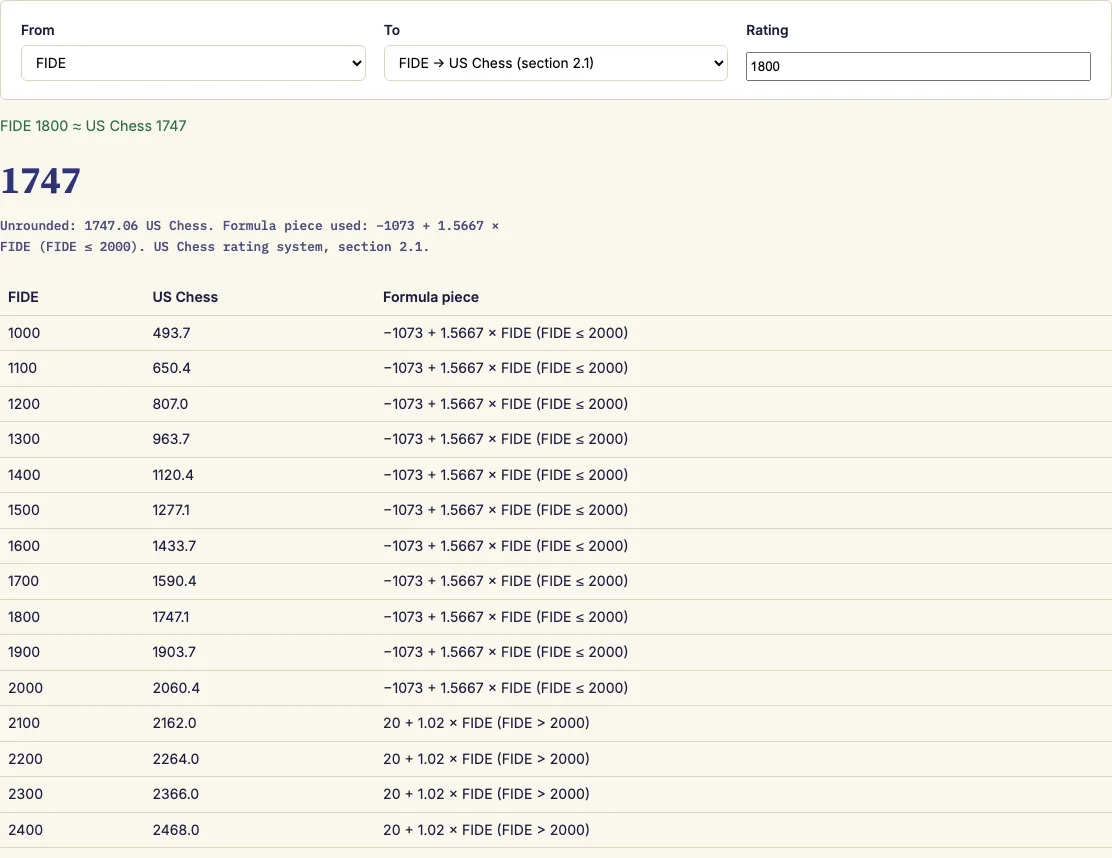
Use it to convert a FIDE rating to US Chess, a Canadian CFC rating to US Chess, or a US Chess rating back to FIDE. It also covers the youth formula used for events such as the World Youth Championships. A table shows ratings from 1000 to 2400 so you can compare a range at a glance.
How to use the chess rating converter
- Open the From menu and choose FIDE, CFC (Canada) or US Chess, depending on the rating you have.
- Open the To menu and choose the formula you need. Each option is named with its section in the US Chess document, so you can check the rules behind it.
- Type the rating into the input box.
- Read the result. It is shown with two decimals and tells you which piece of the formula was used.
- If your number falls where two answers are possible, the tool shows both. If it falls in the CFC gap, the tool says that no CFC rating maps there and shows the nearest edges.
- Scroll down to the table. It converts 1000 to 2400 in steps of 100 and includes a Formula piece column that shows which part of the formula applies to each row.
Example: choose From FIDE and To "FIDE → US Chess (section 2.1)", then type 1500. The result is 1277.05, and the formula piece shown is the one for FIDE ratings up to 2000. Change To to the youth formula and the same 1500 gives 1447.05.
The table is the quickest way to see how a whole range of ratings converts. Each row can be checked against the result box if you want a single exact value.
How do you convert a FIDE rating to a US Chess rating?
Use the formula from section 2.1 of the US Chess document, effective 1 March 2024. For FIDE ratings up to 2000, US = −1073 + 1.5667 × FIDE; above 2000, US = 20 + 1.02 × FIDE. For example, FIDE 1500 gives 1277.05 and FIDE 2200 gives 2264.
US Chess uses this formula to give an unrated player with a FIDE rating a starting rating, and to rate US players' results in FIDE events abroad. For youth events such as the World Youth Championships (section 6), the formula is −453 + 1.2667 × FIDE up to 2000 and 80 + FIDE above 2000. FIDE 2200 gives 2280 under this version.
Can I convert a chess.com rating to FIDE?
No, the converter does not offer chess.com. Online sites such as chess.com have their own rating pools and publish no official conversion to FIDE or US Chess. A number from one of those pools cannot be placed reliably on the FIDE or US Chess scale.
If you hold a FIDE or US Chess rating, use the matching option in the From menu. Those are the only starting points the tool supports.
Is the reverse conversion official?
No. The US Chess to FIDE and US Chess to CFC directions are calculated by solving the same formulas backwards. The tool labels them "reverse of the US Chess formula, not an official conversion."
Solving backwards means rearranging each line. For a straight-line piece US = a + b × FIDE, the FIDE value is (US − a) ÷ b. The two FIDE pieces do not meet exactly at 2000, where the lower piece gives 2060.4 and the upper gives 2060. A US rating between 2060 and 2060.4 therefore has two FIDE answers, and the tool shows both.
How are Canadian (CFC) ratings converted?
CFC ratings use section 2.2 of the US Chess document, effective 1 January 2025. The formula has four pieces: −115 + 0.815 × CFC below 1150; −650 + 1.28 × CFC from 1150 to 1609; −856 + 1.41 × CFC from 1610 to 1999; and −240 + 1.1 × CFC from 2000. CFC 1500 gives 1270, and CFC 2200 gives 2180.
The pieces do not join perfectly. Their results overlap slightly near 822 and between 1960 and 1964, so a US Chess rating there can come from two CFC ratings, and the reverse conversion shows both. Between 1410.8 and 1414.1 there is a gap that no CFC rating reaches.
Why are FIDE and US Chess ratings different?
Each federation rates a different pool of players, and each uses its own starting ratings and K-factors. The K-factor controls how much a rating moves after each game. Because of these differences, the same player can have quite different numbers on each scale.
By the section 2.1 formula, the US Chess equivalent is lower than the FIDE rating below about FIDE 1893 and higher above it: FIDE 1500 becomes 1277, FIDE 1893 stays about 1893, and FIDE 2200 becomes 2264.
Examples
FIDE 1500 → US Chess 1277.05
FIDE 2000 → 2060.40
FIDE 2001 → 2061.02
FIDE 2200 → 2264.00
CFC 1500 → US Chess 1270.00
CFC 1999 → 1962.59
CFC 2000 → 1960.00
FIDE 2200 (youth) → 2280.00
US Chess 1277.05 → FIDE 1500.00
Reverse of the US Chess formula — not an official conversion.
Questions and answers
What does the Formula piece column show?
It shows which part of the conversion formula applies to each rating in the table. Ratings on either side of a boundary can use different pieces, so this column tells you which line of the formula was used.
Why does the converter show two answers for one rating?
A US Chess rating between 2060 and 2060.4 has two possible FIDE values, because the two FIDE pieces do not meet exactly at 2000. The tool shows both results so you can see each one.
Why does the tool say no CFC rating matches my number?
The CFC pieces leave a gap between 1410.8 and 1414.1. In that gap, the tool reports that no CFC rating maps there and shows the nearest edges of the gap.
Is this how US Chess sets a first rating from a FIDE rating?
Yes. Section 2.1 is the formula US Chess uses when an unrated player has a FIDE rating. The converted rating counts as 10 games of information when the FIDE rating is above 2000 and 5 games at or below 2000, and the first event is then rated from that starting point.
Does the tool send my rating anywhere?
No. Everything runs in your browser, and nothing is looked up or uploaded.
Why are the results shown with decimals?
Results are shown with two decimals. Official US Chess ratings are rounded to whole numbers, so round the result yourself if you need the figure that matches an official listing.
Related chess tools
Updated