 ChessPuzzlePrint
Chess Piece Value Calculator
Paste a position and see each side’s pieces, their point values and who is ahead in material.
What are the chess piece values?
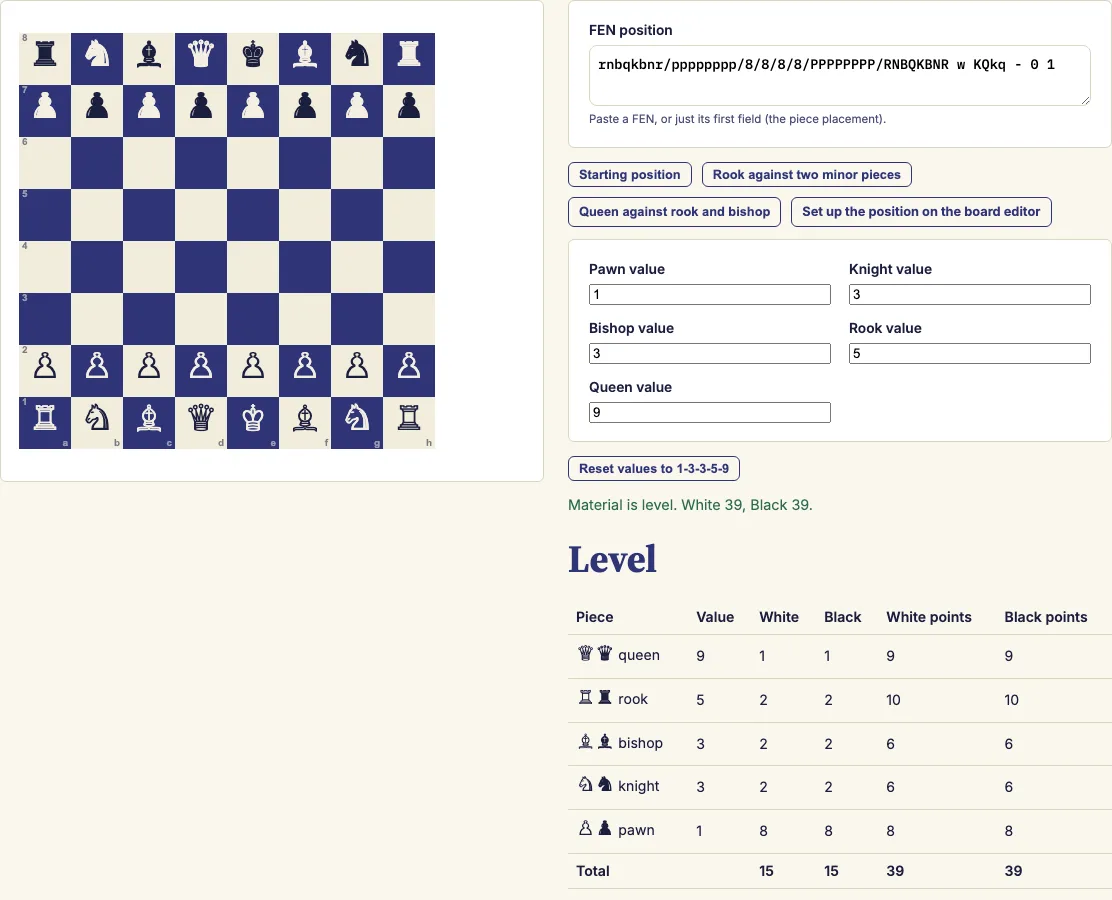
This chess piece value calculator adds up the points of every piece on a board and shows which side has more material. It uses the standard chess piece point value scale: pawn 1, knight 3, bishop 3, rook 5 and queen 9.
You enter a position as a FEN, the short text code that describes where every piece stands. The calculator counts each piece for both sides, multiplies the number of each type by its value and adds the results. It then shows the balance, a table of pieces and points, and any pieces one side has that the other does not.
You can change the values. Any value from 0 to 99 is allowed, including decimals such as 3.25, and the totals update straight away. Use it to check whether a trade or a sacrifice has left you ahead or behind.
How to use the chess piece value calculator
- Paste a FEN into the box, or click one of the example buttons. Only the first part of the FEN, the piece placement, is needed.
- To build a position by hand, open the chess board editor, set up the pieces and copy its FEN back into the box.
- Read the balance at the top, for example "White is up 2 points".
- Check the table for the count and points of each piece type.
- Read the line below the table for the exact difference, such as a rook against a bishop and a knight.
- To use another scale, change any piece value. Click Reset values to return to 1-3-3-5-9.
Each value accepts any number from 0 to 99, including decimals such as 3.25 or 3.5, so you can test a scale that differs from the standard one. The calculator works on any board, even one with no kings, so a partial position from a puzzle or an exercise can be counted too.
The address bar keeps your FEN and any changed values. Share the link to send someone the exact same count. A note appears if a king is missing from the position. The table counts each side's pieces separately, so you can see at a glance which side has more of each type.
What is the point value of each chess piece?
The standard chess piece point values are pawn 1, knight 3, bishop 3, rook 5 and queen 9. The king has no point value, because it can never be captured or exchanged, so it is never counted.
Each side's points are found by multiplying the number of each piece by its value and adding the results together. The balance is White's total minus Black's total. A positive result means White is ahead, and a negative result means Black is ahead.
Both sides start with 39 points of material: 8 pawns (8), 2 knights (6), 2 bishops (6), 2 rooks (10) and a queen (9). The queen is the most valuable piece and the pawn is the least valuable.
These values are guidelines for judging trades, not rules of the game. Material is only a guide. A side that is behind in points can still be winning because of an attack, a passed pawn or a checkmate. Two minor pieces (6 points) against a rook and a pawn (6 points) count as equal, but the actual result depends on the position.
Is a bishop or knight more valuable?
On the standard scale neither is more valuable, because both are worth 3 points. Some books give the bishop slightly more than the knight, so the answer can depend on the scale you use.
Many players value the two bishops together a little higher than two knights or a single bishop. This is called the bishop pair: two bishops on squares of both colours. Bishops usually do better in open positions, where diagonals are long, and knights usually do better in closed positions, where they can jump over blocked pawns. The 1-3-3-5-9 scale does not include the bishop pair, but the calculator shows whether each side has it.
Two bishops on squares of the same colour can only happen after a pawn has promoted to a bishop. These bishops do not form a bishop pair.
Examples
Questions and answers
Which chess piece has the most value?
The queen is the most valuable piece, worth 9 points on the standard scale. The pawn is the least valuable, worth 1 point.
Why do chess pieces have values?
Point values give players a quick way to judge trades and sacrifices. Adding up the points shows whether an exchange has left you ahead or behind. The values are guidelines, not rules of the game.
Does a bishop pair add points?
The calculator does not add extra points for it. Each bishop is counted at its own value, and the calculator only shows whether a side has the pair.
Does the king have a value?
No. The king is not counted in the totals because it can never be captured or exchanged. The calculator gives it no points.
Is the queen worth 9 or 10?
Most books give the queen 9 points, which is the default in the calculator. Some systems use 9.5 or 10. You can change the queen's value to test another scale.
Can I count a position with no kings?
Yes. The count works on any board, even one without kings, which is useful for puzzles and partial games. If a king is missing, the calculator shows a note.
Can I change the piece values?
Yes. Type any value from 0 to 99 for each piece, including decimals such as 3.25, and the totals and balance update immediately. Click Reset values to return to 1-3-3-5-9.
Related chess tools
Open-source components used by this tool: ChessPieces font (Noto Sans Symbols 2 subset) (SIL OFL 1.1).
Updated