 ChessPuzzlePrint
Chess Opening Trainer
Pick an opening, choose your colour and play your side of the line from memory; or test yourself by naming the opening on the board.
What the chess opening trainer does
The chess opening trainer is a free, browser-based tool that teaches you named chess opening lines and tests whether you can recognise them. It draws on a catalogue of 3,800 named opening lines. You can practise a line move by move as White or Black, or identify an opening from a position on the board. Lines are named opening sequences, mostly short, so the trainer suits anyone who wants to memorise the first moves of openings such as the Najdorf or the Italian. Each time you finish a line with no mistakes, the trainer counts it, so you can see your progress build up over time.
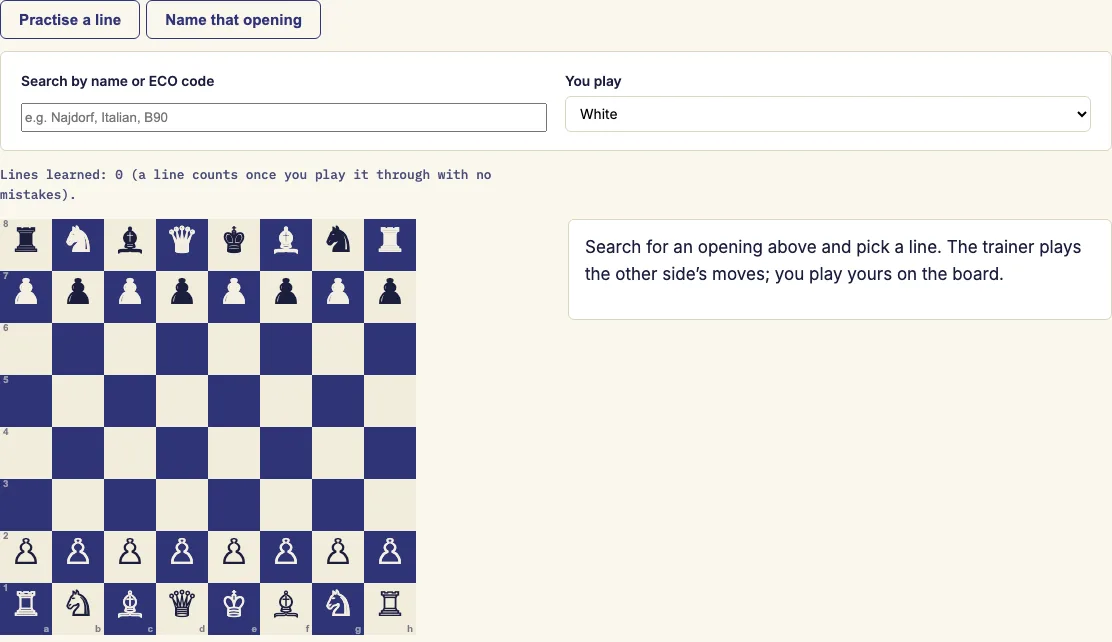
How to use the chess opening trainer
To practise a line:
- Open the Practise a line tab.
- Type a name or ECO code into Search by name or ECO code, for example Najdorf, Italian or B90. Up to 40 matching lines appear.
- Choose You play as White or Black. A line with Defence or Defense in its name suggests Black.
- Select a line. The trainer plays the opponent's moves automatically.
- Click one of your pieces to see its legal squares, then click a destination to move it.
- When a move is correct, the trainer shows "Correct." and the line continues. If you get it wrong, the move flashes red and shows "Try again." After a second wrong try the trainer shows the move the line continues with, and you play it.
- When the line ends, use Repeat line, Another line from this family or Next line. Follow the opening's guide link if one is shown.
To test yourself on recognition:
Open the Name that opening tab.
Study the board, the highlighted last move and the moves written out below it.
Choose one of the four answers to "Which opening is this?"
Use Next question to move on. Your line shows your score, streak and best streak.
The address bar keeps your mode, colour and line, so you can return to the same practice line by reopening that address.
How do you learn chess openings?
You learn an opening by repeating one line until you can play it with no mistakes. A line is a fixed sequence of moves, so repetition is what fixes the order in your memory. Once you finish a line cleanly, switch colours and play the same line from the other side. Then try other lines from the same family, so you start to see the shared ideas behind them.
Recognising an opening by its position is a separate skill, and it is worth practising too. Use the quiz to link a set of moves with the position it creates, so you can name an opening even when you have not just played it.
How does the opening quiz work?
The quiz shows a board after a named line of at least six half-moves, with the last move highlighted and the moves written out. You then choose which opening it is from four answers. The wrong answers come from other opening families, so you have to recognise the specific opening rather than guess that a position looks like "some opening".
Your score and streak update after each answer, so you can see whether your recognition is improving. If you miss a question, look at the moves written out and compare them with the board. That shows you the path that led to the position, which is the link between the moves and the name.
What is an ECO code?
An ECO code is a code from the Encyclopaedia of Chess Openings, a classification that groups openings into five volumes, A to E. Each code runs from A00 to E99, and the first letter tells you the broad group. For example, B90 is a code of the Najdorf Sicilian: volume B covers most semi-open games, where Black answers 1.e4 with something other than 1...e5 (the French Defence, 1...e6, is filed under C).
Searching by ECO code is useful when you know a code from a book or a website but not the opening's name. Lines that share a code often share a family of moves, so a code search can show you related lines to practise next.
Examples
Italian Game: Giuoco Piano (ECO C50), you play White
1. [e4] e5 2. [Nf3] Nc6 3. [Bc4] Bc5

Moves in [brackets] are yours: 3 of 6.
Sicilian Defense: Najdorf Variation, you play Black
1. e4 [c5] 2. Nf3 [d6] 3. d4 [cxd4] 4. Nxd4 [Nf6] 5. Nc3 [a6]

You play 5 of 10 moves; the trainer plays 1. e4 for you to answer.
Questions and answers
Is the opening trainer free?
Yes. The chess opening trainer is a free, browser-based tool. Nothing you do is uploaded anywhere; the page only loads the list of opening lines.
Are the lines checked by an engine?
No. Your moves are checked against the named line, not against engine strength. A sound move that is not the line's next move still counts as a mistake, because lines are named opening sequences rather than engine-checked repertoires.
Is my progress saved?
Yes, but only in the browser you are using. The "Lines learned" count goes up each time you finish a line with zero mistakes, and it is counted separately for White and Black. Because it is stored in that browser, it will not appear on another browser or device.
Can I get the same quiz questions again?
Yes. The quiz uses a seed in the address bar, so the same link gives the same questions in the same order. The address also keeps the mode, colour and line you were using.
How many openings can I practise?
The trainer covers a catalogue of 3,800 named opening lines. You can search them by name or ECO code, and each search lists up to 40 matching lines.
Related chess tools
Open-source components used by this tool: chess-openings catalogue (CC0); chess.js (BSD-2-Clause); ChessPieces font (Noto Sans Symbols 2 subset) (SIL OFL 1.1).
Updated