 ChessPuzzlePrint
Chess Notation Converter
Paste a list of moves in any common notation and get it back in the notation you need, numbered and ready to copy.
What the chess notation converter does
Chess notation is the written record of chess moves, and this chess notation converter reads a move list in any of four common forms and writes it in the form you choose. It runs in your browser. Paste the moves, and the converter plays each one on a board to check that it is legal, so illegal or mistyped moves are flagged instead of passing unnoticed. The four forms are standard algebraic notation (SAN, such as Nf3), long algebraic (Ng1-f3), UCI coordinates used by chess engines (g1f3), and figurine notation (♘f3). Use the converter to switch between them, or to check a move list before you share it.
How to use the chess notation converter
- Paste or type the moves. Move numbers, comments in braces and results such as 1-0 are ignored, so you can paste straight from a PGN.
- If the moves do not start from the normal starting position, paste that position's FEN into the start position field.
- Pick the output notation: SAN, long algebraic, UCI or figurine.
- Pick a layout: numbered on one line, one move pair per line, or moves only without numbers (the usual form for UCI).
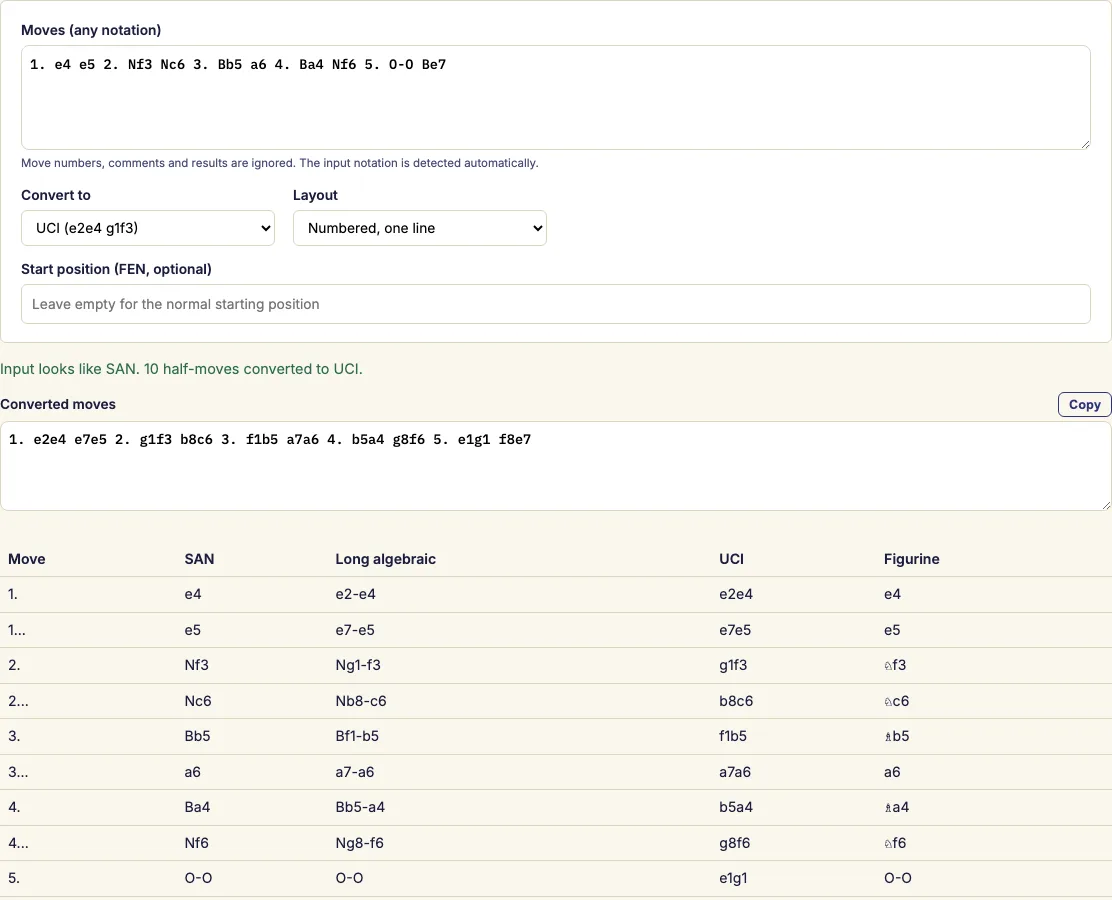
- Copy the result with the Copy button. The table underneath shows every move in all four notations side by side.
The status line tells you which notation the converter read your input as. Mixed lists also work, because each move is read on its own. If a move is illegal or mistyped, the converter stops there, names that move, and still converts the moves before it. Side variations are not handled, so remove them from the text before you convert.
Figurine output uses the outline symbols ♔ ♕ ♖ ♗ ♘ for both sides, as printed books usually do, and pawn moves have no symbol. Castling is written O-O and O-O-O in SAN, long algebraic and figurine notation, and as the king's move in UCI, such as e1g1 for White castling kingside.
Chess notation explained
Chess notation is a way of writing each move so that a game can be recorded, replayed and checked. The most common system is algebraic notation, which names every square with a file letter a-h (left to right from White's side) and a rank number 1-8 (counted from White's side), such as e4. Pieces get a capital letter: K king, Q queen, R rook, B bishop, N knight. Pawn moves have no letter, so e4 means a pawn moves to e4, while Nf3 means a knight moves to f3.
Some symbols add detail. x marks a capture (Nxe5, exd5), + marks a check, and # marks checkmate. O-O is castling kingside and O-O-O is castling queenside. =Q means a pawn promotes to a queen.
When two identical pieces can reach the same square, the file or rank of the moving piece is added so the move is unambiguous, as in Nbd2 or R1e1.
Which notation should I use?
Books and PGN files use standard algebraic notation (SAN), so that is the form most readers expect. UCI is the form used between chess programs and engines. Figurine notation replaces the piece letter with a symbol, so it reads the same in every language. The converter reads any of these four and works out which one you pasted, so you do not have to label the input.
How do you write chess notation?
Write the move number followed by a dot, then White's move, then Black's move. Start with the piece letter (leave it out for pawns), add the destination square, and add the other symbols where they apply. For a pawn capture, give the file the pawn starts on, then x and the destination, as in exd5.
The other common forms change only the detail. Long algebraic adds the starting square, so the knight move becomes Ng1-f3. UCI drops the letter and gives only the two squares, so the same move is g1f3. A promotion in UCI adds the new piece as a lower-case letter, as in e7e8q.
Examples
1. e4 e5 2. Nf3 Nc6 3. Bb5 a6 4. Ba4 Nf6 5. O-O Be7
↓ UCI
1. e2e4 e7e5 2. g1f3 b8c6 3. f1b5 a7a6 4. b5a4 g8f6 5. e1g1 f8e7
d2d4 g8f6 c2c4 e7e6 b1c3 f8b4 e2e3 e8g8
↓ figurine, one pair per line
1. d4 ♘f6
2. c4 e6
3. ♘c3 ♗b4
4. e3 O-O
FEN 3k4/8/8/8/4P3/8/p7/4K3 w - - 0 1
e5 Kd7 e6+ Kxe6 Kd2 a1=Q
↓ long algebraic
1. e4-e5 Kd8-d7 2. e5-e6+ Kd7xe6 3. Ke1-d2 a2-a1=Q
Questions and answers
What does ++ mean in chess?
In some older books, ++ marks checkmate or a double check. Modern algebraic notation uses # for checkmate, so use # when you write moves today.
How is a knight written in chess notation?
A knight is written with the letter N, because K is already used for the king. Nf3 means a knight moves to f3, and Nbd7 means the knight on the b-file goes to d7 because another knight could also reach it. In long algebraic it is Ng1-f3, in UCI it is g1f3, and in figurine notation it is ♘f3.
What do ! and ? mean in chess notation?
They are annotation symbols that comment on a move's quality. ! is a good move, !! a brilliant move, ? a mistake, ?? a blunder, !? an interesting move and ?! a dubious move. The converter skips these symbols when it reads a pasted move list.
What is the old (descriptive) chess notation?
Descriptive notation, used in older English books, names squares from each player's own side of the board, so 1.e4 is written P-K4. It is different from algebraic notation, and this converter does not read or write it. Convert those moves to algebraic notation before you paste them.
What does a chess notation example look like?
The opening 1. e4 e5 2. Nf3 Nc6 3. Bb5 is written as 1. e2-e4 e7-e5 2. Ng1-f3 Nb8-c6 3. Bf1-b5 in long algebraic. In UCI it is e2e4 e7e5 g1f3 b8c6 f1b5, with no move numbers if you choose the moves-only layout.
Related chess tools
Open-source components used by this tool: chess.js (BSD-2-Clause).
Updated