 ChessPuzzlePrint
Chess Checkmate
Find the checkmate in six classic positions and see why the king cannot escape.
What this chess checkmate page does
This is a free chess checkmate tool that runs in your web browser, with no sign-up and nothing uploaded. It gives you six checkmate patterns, each a position with White to move and one move that delivers checkmate.
You pick a pattern, find the mating move, and the tool checks it against the rules of chess. A correct move confirms the checkmate and explains why the king has no escape. Use it to learn checkmate in chess, from the basic mating patterns to the trickier ones such as Boden's mate.
You can work through them in any order.
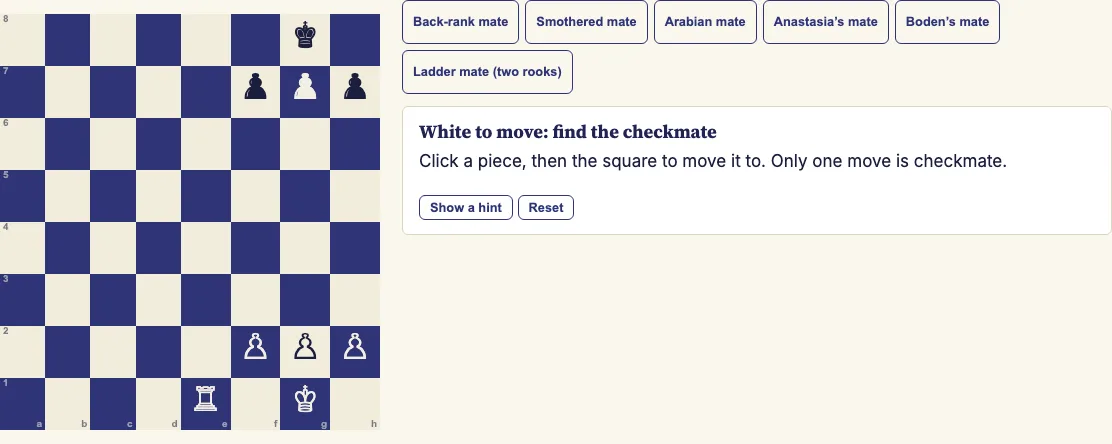
How to use the Chess Checkmate tool
- Open the page. It starts on the Back-rank mate pattern.
- To change the pattern, click one of the six buttons: Back-rank mate, Smothered mate, Arabian mate, Anastasia's mate, Boden's mate or Ladder mate (two rooks).
- Read the position. White is to move, and one move gives checkmate.
- Click the piece you want to move.
- Click the square you want to move it to.
- Read the message. A wrong move shows "is not checkmate. Press Reset and try again." A right move shows "is checkmate: the" followed by the pattern name, and an explanation.
- If you are stuck, click "Show a hint". It selects the right piece and marks its target square.
- Click "Reset" to set the position up again and try the pattern once more.
- After a correct move, read the explanation under the board: it lists the pieces that give check and the squares around the king, one by one.
The explanation after a correct move is worked out from the final position, not typed in advance. It names the piece or pieces giving check, the squares next to the king that its own pieces block, the squares White covers, and whether the checking piece is protected.
What is checkmate in chess?
Checkmate is a position in which the king is in check and the player to move has no legal way out of it. The king cannot move to a safe square, the attacking piece cannot be captured, and the check cannot be blocked. Checkmate ends the game, and the side that gave it wins.
Check alone is not the same thing. Most checks can be answered, so a check only becomes checkmate when all three escapes are gone. The tool's chess rules come from the chess.js library, which checks every move against the standard rules, so every answer on the page is legal play.
What are the common checkmate patterns?
Checkmate patterns repeat because the king's own pieces and the edge of the board limit where it can go. The tool has six patterns:
Learn to spot the pattern first. Once you see which squares the king's own pieces block, the mating move is usually the one that covers the last open square.
- Back-rank mate (Re8#): a rook reaches e8 against a king on g8 whose pawns on f7, g7 and h7 block its own escape squares.
- Smothered mate (Nf7#): a knight jumps from g5 to f7 against a king on h8 boxed in by its own rook on g8 and pawns on g7 and h7. The knight is not next to the king, so the king cannot capture it.
- Arabian mate (Rh7#): a rook reaches h7 against a king in the corner on h8, protected by a knight on f6 that also covers g8.
- Anastasia's mate (Rh1#): a rook checks along the h-file against a king on h7, with a knight on e7 covering g6 and g8.
- Boden's mate (Ba6#): two bishops on crossing diagonals trap a king on c8 whose own pieces block d7 and d8.
- Ladder mate (Rb8#): two rooks work together. One covers the seventh rank, and the other checks along the eighth rank against a king on h8.
Examples
Questions and answers
What is the difference between checkmate and stalemate?
Checkmate happens when the player to move is in check and has no legal escape, and the attacking side wins. Stalemate happens when the player to move has no legal move but is not in check, and the game is a draw.
How do I practise checkmates?
Work through the six patterns on this page, using the hint button when you are stuck and Reset to try again. Then move on to puzzles that ask you to find a mate, which build the same skill in a wider range of positions.
What is a back-rank mate?
A back-rank mate is a checkmate delivered by a rook or queen along the king's back rank, where the king is trapped by its own pawns. The tool's example is Re8# against a king on g8.
What is a smothered mate?
A smothered mate is a checkmate in which the king is surrounded by its own pieces, so it cannot move, and a knight delivers check from a square the king cannot reach to capture. The tool's example is Nf7# against a king on h8.
How do I checkmate in chess?
Aim to check the king in a way that leaves it no escape square, no capture of the attacker and no block. Look for checks that cover the squares the king could run to, and check whether the king's own pieces are getting in its way.
Does the tool play against me?
No. The tool gives you positions to solve, with one correct checkmating move each, and it checks the move you choose.
Related chess tools
Open-source components used by this tool: chess.js (BSD-2-Clause).
Updated