 ChessPuzzlePrint
Chess Board Vision Trainer
Is f6 light or dark? Can a knight get from b1 to d2? Answer as many as you can before the clock runs out.
What the chess board vision trainer drills
The board vision trainer is a chess drill that tests how well you can see the board in your head. You get short questions about square colours, knight moves and diagonals, answered against a 30 or 60 second clock. Your best score for each drill and time is saved in this browser.
The drills start with square colour and move on to knight routes and diagonals. Board vision is the skill behind calculating quickly and playing blindfold chess. This trainer helps you build it one question at a time, and each answer shows the reason so you can learn from mistakes as you go.
How to use the board vision trainer
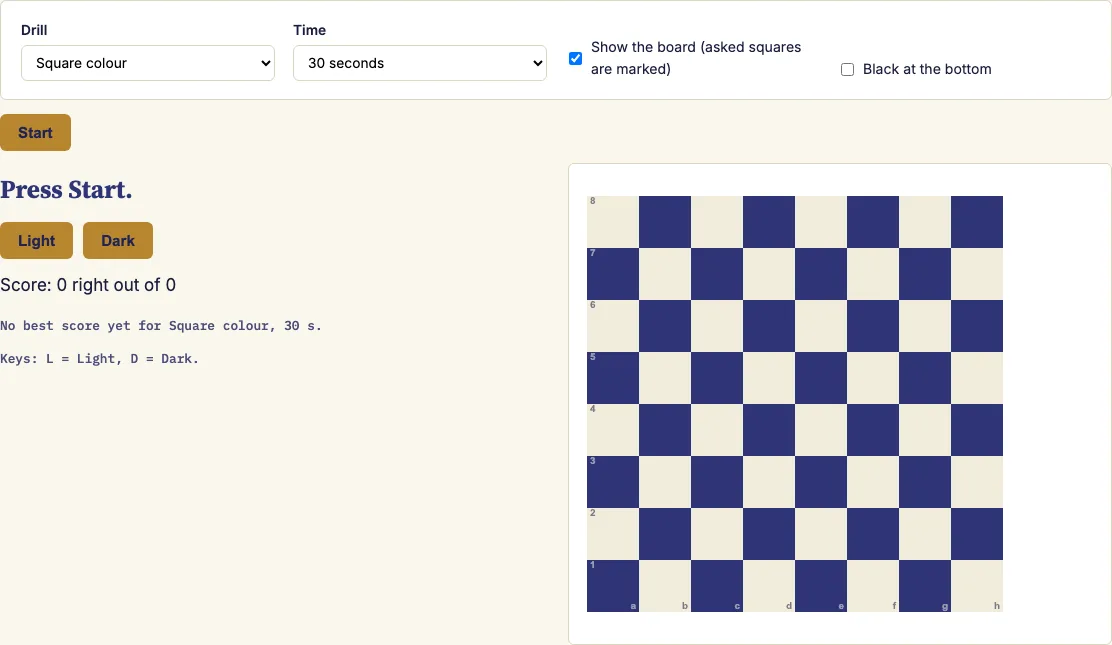
- Choose a drill: square colour, knight in one move, fewest knight moves, or same diagonal.
- Choose 30 or 60 seconds.
- Decide whether to show a board with the asked squares marked. The highlight covers the square colour, so you still have to work out the answer.
- Press Start.
- Answer each question with the buttons, or with the keys shown under them: L or D for light and dark, Y or N for yes and no, and 1 to 6 for a number of knight moves.
- Read the feedback line after each answer to see the correct result and the reason, such as the knight route or the distance between two squares.
- When time is up, compare your score with your best for that drill and time, then press Start to try again.
The keys are shown directly under the answer buttons. Each run lasts 30 or 60 seconds, as chosen, and every drill and time combination keeps its own best score.
Each run uses one drill and one time setting. To see progress, repeat the same drill at the same time and compare your new score with the saved best for that combination. A run's score is the number of correct answers it contains, so a higher number means more questions answered right in the time you chose.
What is board vision in chess?
Board vision is the ability to see the chessboard in your head. It means knowing the colour of any square, where a knight can jump, and which squares share a diagonal, all without counting them out on a real board.
Strong board vision makes calculation faster, because you can check a line in your head instead of setting up pieces. It is also the foundation for blindfold chess, where you must track the whole position without seeing it.
Square colour is the first thing to master. Number the files a to h as 1 to 8, then add the rank number. An even total means a dark square and an odd total means a light one. For example, f6 is 6 + 6 = 12, so f6 is dark. a1 is dark and h1 is light.
Two more rules cover most of the drills. Knight moves always change square colour, so a knight on a light square can only reach dark squares in one move. Two squares lie on the same diagonal when they are the same number of files apart as ranks apart.
How do I improve my chess vision?
Learn the rules until you can apply them without thinking, then practise with short timed drills and turn the board off as soon as you can. Seeing the answer in your head is the skill you are building. Relying on the marked squares will not build it.
Start with colour, then add knight moves and diagonals. Knight distances are the harder part. The trainer finds the shortest route by searching outward from the starting square one knight move at a time, until it reaches the target. You can learn the same method by hand: list every square you can reach in one move, then every square reachable from those, and so on.
Corners are good places to start because they restrict the knight the most. From a1, the knight can only reach b3 and c2. From neither of those can it reach b2 in fewer than three more moves. On an 8 × 8 board, no two squares are more than six knight moves apart.
Check each answer's explanation, even when you are right. A correct guess with a wrong reason will fail you in a real game.
How long should I train?
Short, focused sessions work better than long ones. Play one or two runs of 30 seconds, then stop while you are still concentrating. Tiredness makes you guess, and guessing does not build board vision.
Use the 60 second setting once the 30 second runs feel comfortable. Keep the board off for most runs, and turn it on only when you want to check a pattern you are learning. Come back each day rather than trying to finish everything in one sitting.
Examples
Is f6 light or dark?
f = 6, 6 + 6 = 12 (even)
Answer: dark
Fewest knight moves a1 → h8: 6
a1 → b3 → c5 → d7 → f8 → g6 → h8

Fewest knight moves a1 → b2: 4
a1 → b3 → c5 → d3 → b2

From a1 a knight reaches: b3, c2
Are c1 and h6 on the same diagonal? Yes
(5 files and 5 ranks apart)

Are b2 and g6 on the same diagonal? No
(5 files but 4 ranks apart)
Questions and answers
How is my score counted?
Your score is the most correct answers you give in one run at the time you chose. If two runs have the same number, the run with higher accuracy counts as the better one.
What does the feedback show after each answer?
It shows the correct result and a short explanation, such as the knight route or the distance between two squares. Read it even when you were right, since a correct guess with a wrong reason will not help you in a real game. Compare the reason with your own working so you know which step you missed.
Are my best scores saved?
Yes, but only in the browser you are using. Clearing your site data removes them, and scores from another device or browser will not appear.
Can I use the keyboard instead of the buttons?
Yes. Press L or D for light and dark, Y or N for yes and no, and 1 to 6 for knight-move counts. The keys are shown under each set of buttons.
Should I keep the board on?
Keep it on while you learn a drill, so you can see the marked squares and understand the pattern. Turn it off once you can answer correctly without it, because that is the skill that carries over to real games.
Related chess tools
Updated