 ChessPuzzlePrint
Blindfold Chess Trainer
The board stays hidden. Type your moves, read the computer’s replies, and keep the position in your head.
What is blindfold chess?
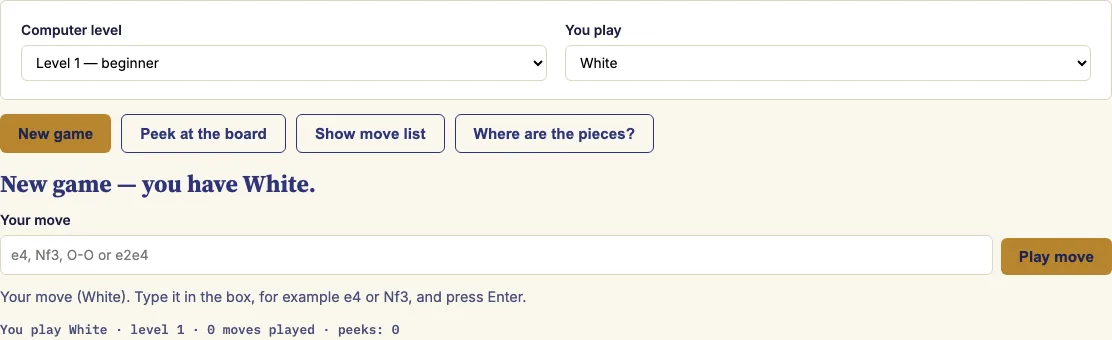
Blindfold chess is playing chess without looking at the pieces. The blindfold chess trainer on this page lets you play a full blindfold chess game against a chess engine that runs in your browser, with the board hidden. You type each move, and the computer replies in text with its own move and a plain description, such as "knight from g8 to f6". You can choose one of five strength levels, so you can start easy and work up.
The board stays hidden, so you have to keep the whole position in your memory. If you get lost, you can peek at the board or list where the pieces stand. Every peek is counted, so you can see how your play improves over time.
How to use the blindfold chess trainer
- Choose the computer level and your colour, then press New game. If you play Black, the computer moves first.
- Type your move in the box and press Enter. Standard notation (e4, Nf3, exd5, O-O, e8=Q) and from-to squares (e2e4, g1f3, e7e8q) both work, and lower-case piece letters are accepted.
- Read the computer's reply in the line above the box and in the status line.
- Open the move list to check the game so far. Use Peek at the board or Where are the pieces? only when you need them; the board hides again after your next move.
- Keep playing until the game ends. The trainer tells you whether it is checkmate, stalemate, a draw by repetition, the fifty-move rule or insufficient material.
Type O-O for kingside and O-O-O for queenside castling (0-0 and 0-0-0 work too), or the king's from-to squares such as e1g1. For a promotion, type e8=Q, e8Q or e7e8q. A lower-case b is read as a pawn move first, so bxc3 is a pawn capture. If no such pawn move exists, it is read as a bishop move, so after 1.e4 e5, typing bc4 plays Bc4. Illegal moves are rejected with a message. Copy the move list if you want to keep it.
How does blindfold chess work?
In blindfold chess, at least one player does not see the board. That player follows the game from the announced moves, usually in algebraic notation, and keeps the whole position in memory. You hear or read each move, then update the position in your head.
In this trainer, the board is hidden while you play, and the computer announces its replies in text. You track the pieces yourself. When you lose track, a peek shows the position, but each peek is counted, so the aim is to finish with as few as possible.
Say each move to yourself with the piece and both squares, as the trainer writes it: "bishop from f1 to c4". It helps the position stick. Before you move, ask which of your pieces are undefended, because most blindfold mistakes are pieces left hanging.
Is blindfold chess useful?
Yes, as training. Even if you never play a full blindfold game, practising it trains the same skill you use when you calculate several moves ahead: seeing the board clearly without moving the pieces.
Start with the move list open and the lowest level. Try to finish a game with no peeks before making it harder. Higher levels take longer to reply, because the engine searches deeper. If you often lose track of pieces, practise square colours and knight routes first.
What happens when you make a mistake?
If you type a move that is not legal, the trainer says so and nothing changes on the hidden board; if you are in check, it reminds you. A peek shows the current position from your side with the last move marked, and the board hides again after your next move. The game ends with checkmate, stalemate or a draw by repetition, the fifty-move rule or insufficient material, and the trainer tells you which one it was.
Examples
e4     → e4
e2e4   → e4
nf3    → Nf3
g1-f3  → Nf3
Pe4    → e4
Ke2
“Ke2” is not a legal move here.
e4     e4     pawn from e2 to e4
e5     e5     pawn from e7 to e5
bc4    Bc4    bishop from f1 to c4
Nc6    Nc6    knight from b8 to c6
d1h5   Qh5    queen from d1 to h5
g8f6   Nf6    knight from g8 to f6
Qxf7#  Qxf7#  queen from h5 to f7, taking the pawn — checkmate

1. e4 e5 2. Bc4 Nc6 3. Qh5 Nf6 4. Qxf7#
Checkmate — you win!
Questions and answers
How long does it take to learn blindfold chess?
There is no fixed time, because it depends on how much you practise and how well you already calculate. Start at level 1 with the move list open, and move up only when you can finish a game with no peeks.
Can I play blindfold chess online?
Yes. The blindfold chess trainer runs in your browser and lets you play a full game against a chess engine with the board hidden. You play against the computer, not another person.
What is mental chess?
Mental chess is another name for blindfold chess, and blind chess is also used. In each case, you keep the position in your head rather than looking at the pieces.
How strong is the computer?
Level 1 makes many mistakes and is meant for beginners. Level 5 searches deepest and is the hardest, but it is not a top engine.
What does the peek counter do?
It counts every peek at the board or the piece list, so you can measure your progress over time. It is only there for that purpose.
Is my game saved?
No. The game exists only in this page, and reloading it starts a new game. Copy the move list before you leave if you want to keep it.
Related chess tools
Open-source components used by this tool: chess.js (BSD-2-Clause); js-chess-engine (MIT); ChessPieces font (Noto Sans Symbols 2 subset) (SIL OFL 1.1).
Updated